Premier Danielle Smith Announces Alberta Legislation for Permanent Year-Round Daylight Saving Time
Alberta Premier Danielle Smith and Service Alberta Minister Dale Nally confirmed the provincial government will introduce legislation to permanently eliminate the bi-annual clock change, locking Alberta into year-round Daylight Saving Time.
Choseno Western Canadian Governance Bureau September 4, 2026 2 min read AB, CA
What do you think of the people in this story? Rate them anonymously — tap a face below.
EDMONTON — Alberta is preparing to formally abandon the century-old practice of changing clocks twice a year, as Premier Danielle Smith and Service Alberta and Red Tape Reduction Minister Dale Nally announced plans to introduce legislation establishing permanent, year-round Daylight Saving Time across the province.
The proposed statutory reform would end the semi-annual ritual of springing forward in March and falling back in November, anchoring Alberta indefinitely in the summer daylight time zone—a standard Premier Smith colloquially dubbed Alberta Time. Provincial officials indicated that the bill will be brought forward during the upcoming legislative sitting of the Legislative Assembly in Edmonton, positioning Alberta to become one of the first Canadian provinces to permanently transition away from seasonal clock adjustments.
Premier Smith framed the policy as a practical, quality-of-life modernization supported by growing medical consensus and overwhelming public frustration with biannual disruptions. Epidemiological and sleep medicine research consistently highlights that the sudden loss of an hour of sleep during spring transitions correlates with measurable spikes in workplace accidents, heart attacks, strokes, and fatal traffic collisions, alongside productivity losses estimated in the hundreds of millions of dollars across North American economies.
Minister Dale Nally emphasized that the administration has actively monitored legislative frameworks in neighboring jurisdictions. While a previous 2021 provincial plebiscite narrowly rejected permanent daylight time by a margin of 50.2 percent to 49.8 percent—largely driven by concerns over late winter morning sunrises in northern communities like Grande Prairie—Nally noted that shifting regional dynamics, including British Columbia's conditional legislation and persistent federal efforts in the western United States, make permanent regional alignment feasible.
The announcement has reignited debate among educational boards, agricultural organizations, and commercial transportation sectors. Rural school trustees and pediatric specialists noted that winter mornings under permanent daylight saving time will mean children waiting for rural school buses in total darkness until after 9:00 a.m. in northern latitudes, urging the province to pair time-zone stabilization with flexible school start times and enhanced crosswalk illumination.
Conversely, retail associations, golf course operators, and tourism promoters across Calgary and Edmonton strongly praised the move, asserting that extended evening daylight hours throughout the autumn and winter months will stimulate after-work commercial activity and support outdoor recreation.
The provincial government confirmed that stakeholder consultations with aviation regulators, cross-border financial markets, and municipal leaders will conclude ahead of the bill's formal introduction.
Rate the people mentioned in this article


Related Coverage in Governance
See all Governance newsGovernance
US Sep 8, 2026
Governor Gavin Newsom Acknowledges Federal Justice Department Inquiries Concerning Nonprofit Records
California Governor Gavin Newsom has publicly disclosed that federal investigators from the Department of Justice are conducting document and financial inquiries involving him and First Partner Jennifer Siebel Newsom, prompting a fierce dispute over federal oversight impartiality and nonprofit compliance.
Read full article

Governance
US Sep 8, 2026
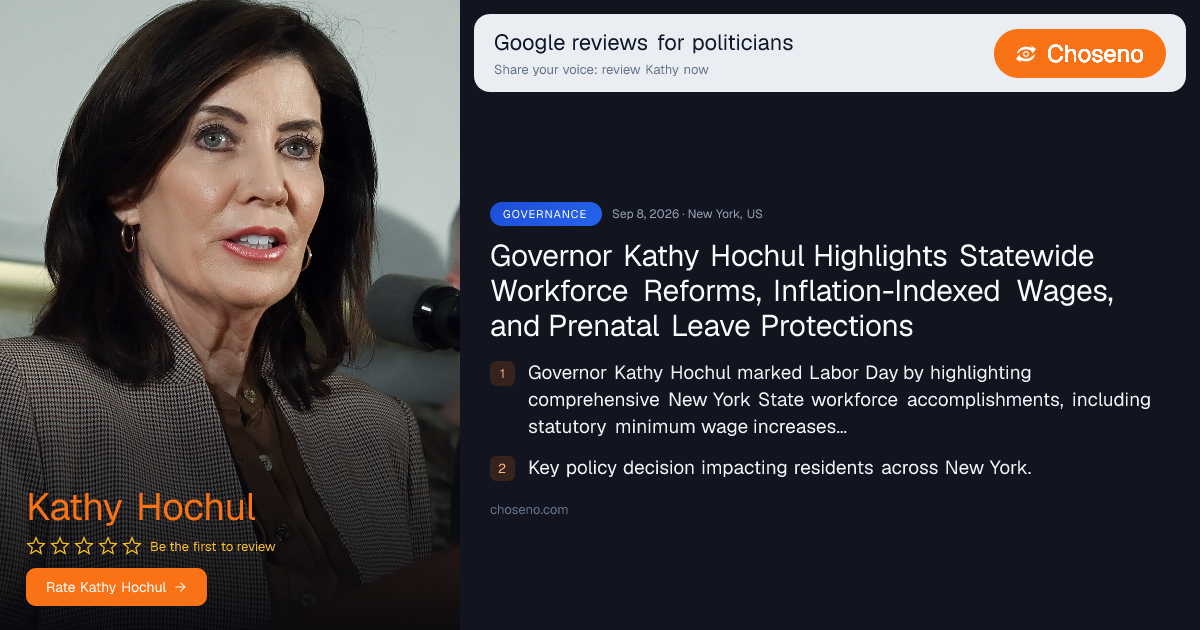
Governor Kathy Hochul Highlights Statewide Workforce Reforms, Inflation-Indexed Wages, and Prenatal Leave Protections
Governor Kathy Hochul marked Labor Day by highlighting comprehensive New York State workforce accomplishments, including statutory minimum wage increases indexed to inflation, implementation of the nation first mandatory paid prenatal leave law, and the full elimination of the state unemployment insurance debt.
Read full article
Governance
US Sep 7, 2026
New Jersey Governor Mikie Sherrill Reaches Agreement With 17 Public Sector Unions Waiving Health Premium Hikes
New Jersey Governor Mikie Sherrill and 17 state employee labor unions have finalized an agreement waiving scheduled 2027 health benefit contribution rate increases and creating an advisory working group to overhaul the State Health Benefits Program.
Read full article