Governor Gavin Newsom Highlights Record Low California Homicide Rate and UC Berkeley Violence Prevention Study
California Governor Gavin Newsom highlights Department of Justice crime data showing the lowest homicide rate since 1966, alongside a UC Berkeley study evaluating state-funded community violence intervention programs.
Choseno Civic News Desk September 4, 2026Updated September 6, 2026 3 min read California, US
California Governor Gavin Newsom this week highlighted newly released statewide criminal justice data alongside an independent academic evaluation from the University of California, Berkeley, arguing that California’s coordinated public safety strategy—combining targeted law enforcement operations with community-based violence interruption programs—is delivering historic reductions in violent crime.
According to formal crime statistics compiled by the California Department of Justice, the state’s overall homicide rate fell to 3.5 per 100,000 residents in 2025, marking the lowest homicide rate recorded in California since standardized statewide statistical reporting commenced in 1966. The annual report demonstrated declines across every major violent and property crime category, with state officials noting that since Governor Newsom assumed office in 2019, statewide homicides have decreased by 20 percent, robberies have fallen by 31 percent, and property crimes have dropped by 24 percent.
The statistical release coincided with the publication of a longitudinal study conducted by the UC Berkeley Center for Global Healthy Cities, which evaluated 14 years of community violence intervention outcomes in Richmond, California. Researchers compared Richmond against dozens of socioeconomically similar metropolitan areas nationwide, finding that the city’s Office of Neighborhood Safety achieved an estimated 61 percent reduction in firearm homicides and injury shootings over more than a decade. The study established that sustained municipal gun violence reductions expanded over time as community-based outreach workers intervened with high-risk individuals before disputes escalated into armed conflict.
A substantial portion of Richmond’s operational funding was supplied through the California Violence Intervention and Prevention (CalVIP) grant program, which is administered at the state level by the Board of State and Community Corrections. Under Newsom’s administration, state budgetary allocations for CalVIP expanded from approximately $9 million annually to an eightfold investment, culminating in the passage of Assembly Bill 28, which established the first dedicated, permanent funding stream for community violence prevention in the United States through an excise tax levied on retail sales of firearms and ammunition.
In addressing state public safety priorities, Newsom emphasized that sustainable crime reduction requires pairing proactive community health interventions with rigorous law enforcement accountability. The administration noted that the California Highway Patrol has significantly scaled up specialized interdiction task forces, deploying coordinated surge operations across metropolitan transit hubs and commercial retail districts to intercept illicit fentanyl trafficking networks and dismantle organized retail theft syndicates.
While administration officials presented the empirical data as validation of California’s multi-layered criminal justice framework, the policy debate remains sharply contested in Sacramento and local municipal council chambers. Conservative critics, county prosecutors, and business coalitions have contended that persistent quality-of-life concerns, urban encampments, and repeat shoplifting operations continue to strain downtown commercial corridors, arguing that structural statutory reforms under Proposition 47 and subsequent legislative amendments should impose stricter criminal penalties and mandatory treatment sentences for repeat offenders.
Conversely, public health researchers, municipal violence prevention directors, and civil rights advocates maintain that sustainable crime deterrence cannot rely exclusively on incarceration, emphasizing that community-led conflict mediation, youth employment programs, and hospital-based violence intervention offer verifiable reductions in recidivism at a fraction of correctional costs. As the state legislature prepares for its next statutory session, California's public safety framework will continue to serve as a high-profile national testing ground for the integration of social epidemiology into modern statewide law enforcement.
Rate the people mentioned in this article

Related Coverage in Public Safety
See all Public Safety newsPublic Safety
US Sep 4, 2026
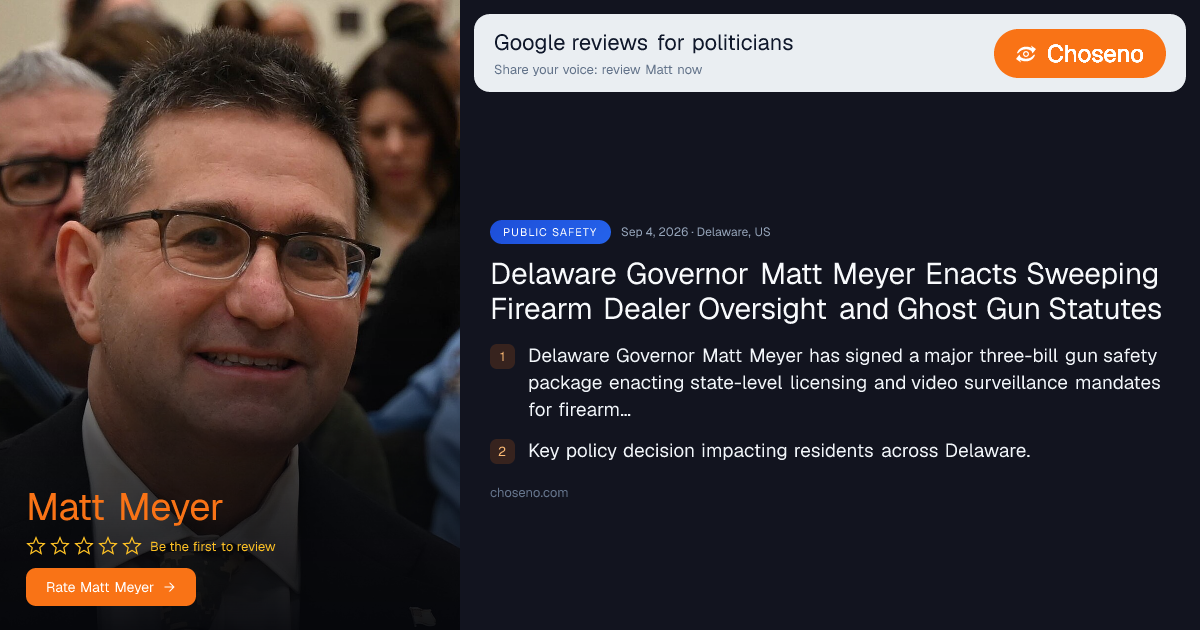
Delaware Governor Matt Meyer Enacts Sweeping Firearm Dealer Oversight and Ghost Gun Statutes
Delaware Governor Matt Meyer has signed a major three-bill gun safety package enacting state-level licensing and video surveillance mandates for firearm dealers, strict serialization rules for ghost guns, and permanent funding for community violence intervention.
Read full article
Public Safety
US Sep 3, 2026
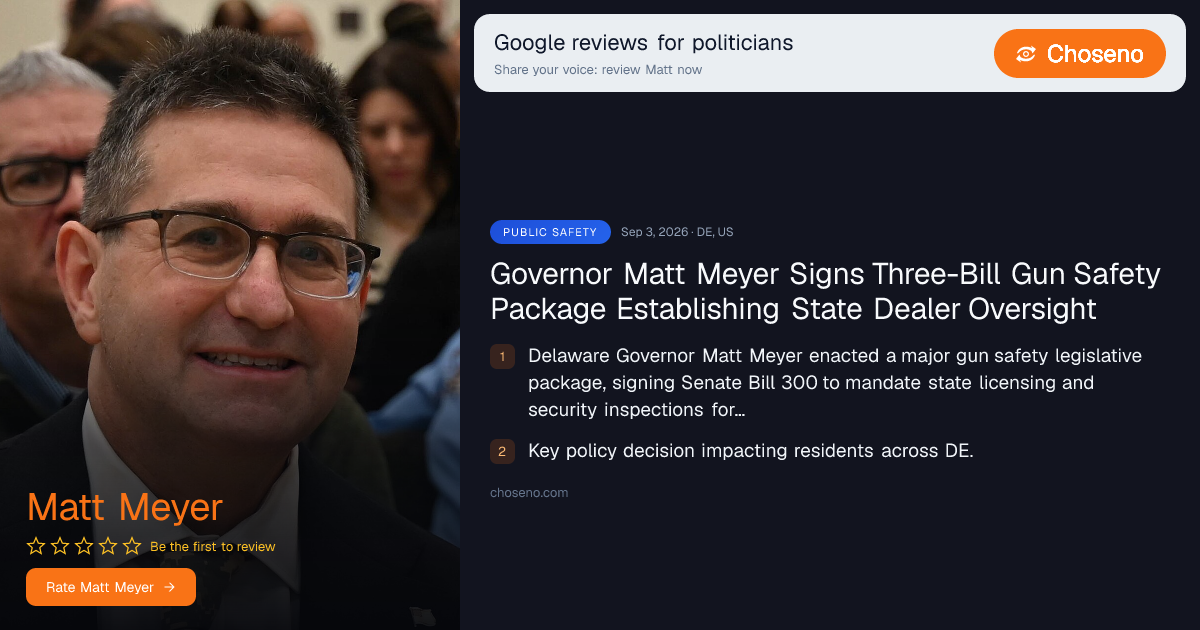
Governor Matt Meyer Signs Three-Bill Gun Safety Package Establishing State Dealer Oversight
Delaware Governor Matt Meyer enacted a major gun safety legislative package, signing Senate Bill 300 to mandate state licensing and security inspections for firearms dealers alongside ghost gun crackdowns.
Read full article
Public Safety
US Sep 3, 2026
Governor Greg Abbott Surveys Ross Fire Devastation and Outlines Agricultural Relief in North Texas
Texas Governor Greg Abbott traveled to Palo Pinto County to survey damage from the 90,000-acre Ross Fire, serving meals to frontline firefighters and announcing state agricultural recovery assistance as containment lines stabilize.
Read full article