Assemblymember Carl DeMaio Challenges Proposed California Vehicle Mileage Road Charge
California State Assemblymember Carl DeMaio has launched an aggressive public opposition campaign against proposed per-mile road usage fees, arguing the measure compounds transit costs for suburban commuters and raises significant digital privacy concerns.
Choseno Civic News Desk September 4, 2026 2 min read CA, US
A contentious fiscal debate over the long-term future of California highway and bridge maintenance funding has intensified as state Assemblymember Carl DeMaio (R-San Diego) launched a statewide public opposition campaign against proposed per-mile vehicle road usage charges.
Speaking during an appearance on Fox Business network, DeMaio sharply criticized state transportation agency proposals to transition from traditional per-gallon motor vehicle fuel taxes to an automated mileage-based fee structure. Transportation planners at the California Department of Transportation (Caltrans) and the California Transportation Commission have piloted road-charge frameworks designed to generate alternative revenue as the accelerating adoption of electric vehicles (EVs) and fuel-efficient hybrids steadily erodes state excise gas tax receipts.
Under frameworks evaluated in recent pilot studies, motorists could be assessed between six and nine cents for every mile driven on California public roadways. Transportation officials argue that with California statutory mandate phasing out the sale of new internal combustion vehicles by 2035, the traditional 59.6-cent-per-gallon state excise gas tax will face steep structural revenue shortfalls, leaving highway rehabilitation and seismic bridge retrofit funds severely underfunded.
However, DeMaio and fiscal conservative organizations contend that layering a mileage fee onto California existing vehicle registration fees and high commercial fuel costs will disproportionately harm working-class commuters in the Inland Empire, Central Valley, and outer suburban districts who must travel long distances to job centers.
Working Californians are already subjected to the highest gas taxes, vehicle license fees, and energy rates in the nation, DeMaio stated during broadcast remarks. Imposing an additional tracking charge of several cents per mile creates an intolerable financial burden on families who cannot afford to live near coastal employment centers.
In addition to economic cost concerns, DeMaio highlighted unresolved Fourth Amendment and digital privacy questions associated with mileage verification. Methods under state review—including in-vehicle GPS transponders, telematics data harvesting, and mandatory annual odometer audits—have generated bipartisan skepticism regarding the state government ability to track residential travel patterns and aggregate geolocation data.
Transportation advocates and municipal engineering associations maintain that without a sustainable replacement for declining gas tax receipts, local governments will face severe deficits in maintaining neighborhood asphalt paving, stormwater culverts, and bridge safety. The debate is expected to remain a prominent policy divide in Sacramento as lawmakers prepare for comprehensive transportation infrastructure negotiations in the upcoming legislative session.
Rate the people mentioned in this article

Related Coverage in Transportation
See all Transportation newsTransportation
US Aug 25, 2026
Federal Transit Administration Directs $380 Million for Zero-Emission Bus Rapid Transit Corridors
Transportation Secretary Pete Buttigieg and FTA Administrator Nuria Fernandez award $380 million in Low-No Emission and Capital Investment Grants to deploy 350 battery-electric articulated buses, dedicated transit-priority lanes, and depot charging hubs across 14 mid-sized US transit agencies.
Read full article
Transportation
CA Aug 25, 2026
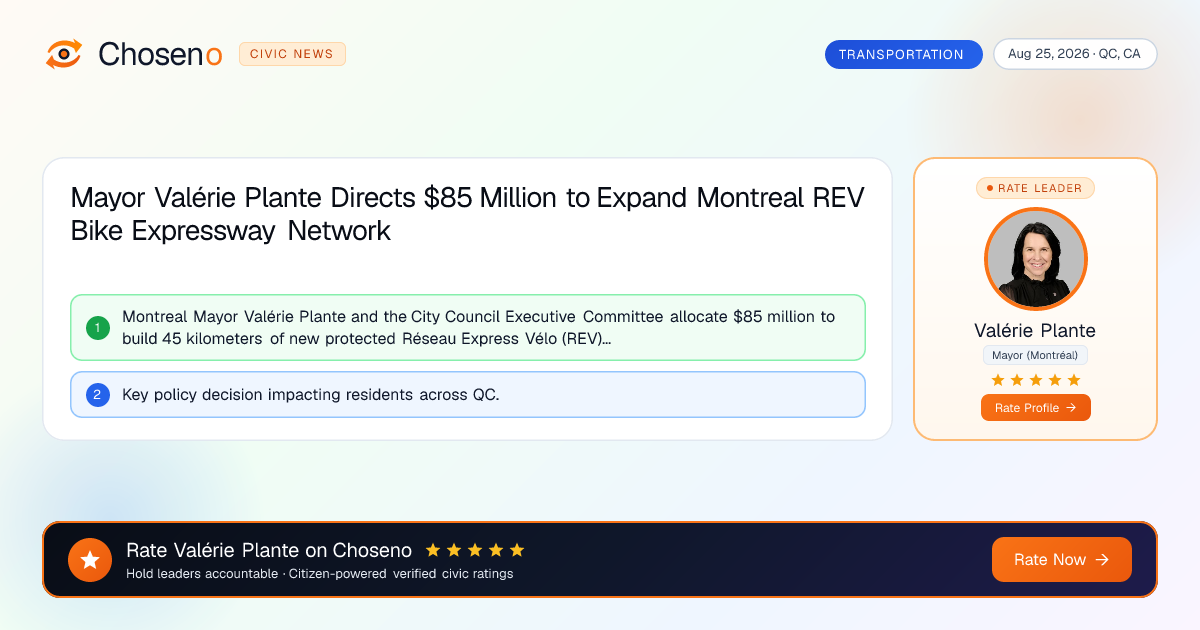
Mayor Valérie Plante Directs $85 Million to Expand Montreal REV Bike Expressway Network
Montreal Mayor Valérie Plante and the City Council Executive Committee allocate $85 million to build 45 kilometers of new protected Réseau Express Vélo (REV) bike expressways, heated intersection crossings, and permanent pedestrian plazas across six boroughs.
Read full article
Transportation
US Aug 25, 2026
Governor Jared Polis Directs $135 Million for Colorado Front Range Passenger Rail Expansion
Colorado Governor Jared Polis and the Front Range Passenger Rail District allocate $135 million from state transit revenues to engineer double-tracking, passenger passing sidings, and station platforms connecting Fort Collins, Denver, and Pueblo.
Read full article