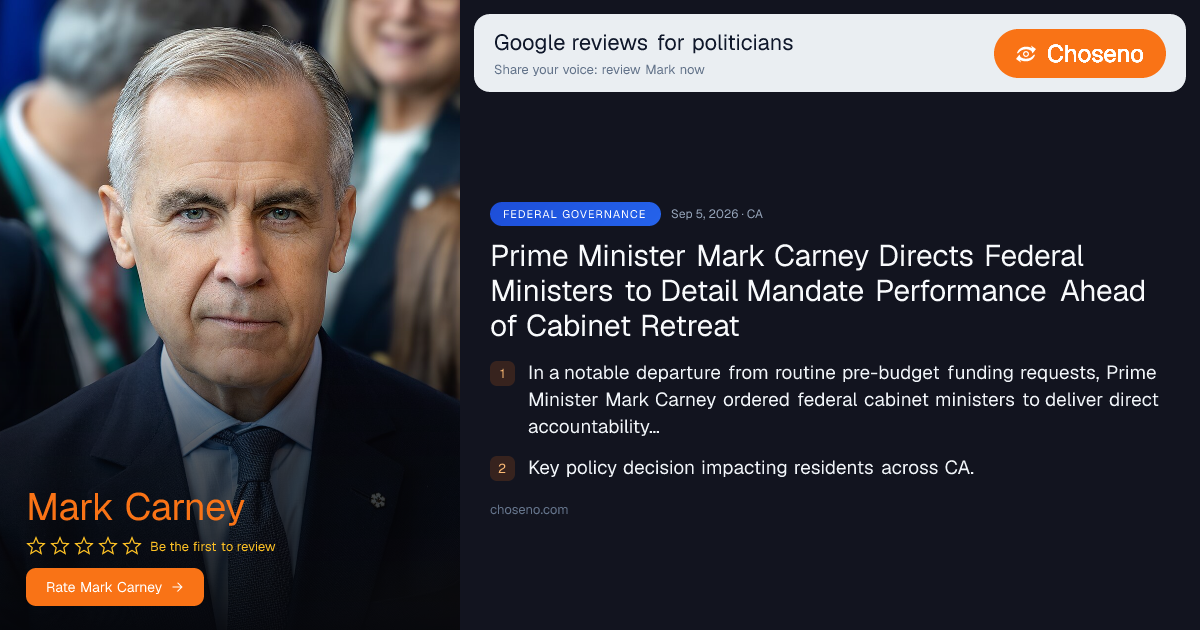
Prime Minister Mark Carney and Alberta Premier Danielle Smith Advance Landmark West Coast Pipeline Implementation Agreement
Prime Minister Mark Carney and Alberta Premier Danielle Smith formalized a landmark intergovernmental energy accord, expediting federal approvals for a million-barrel-per-day West Coast oil pipeline corridor with Indigenous equity participation.
Choseno Civic News Desk September 5, 2026 2 min read CA
What do you think of the people in this story? Rate them anonymously — tap a face below.
CALGARY, Alta. — Prime Minister Mark Carney and Alberta Premier Danielle Smith have finalized a comprehensive implementation agreement operationalizing their joint Memorandum of Understanding, establishing a binding federal-provincial roadmap to build a new million-barrel-per-day oil export pipeline connecting Alberta’s energy basin to Pacific tidewater at Roberts Bank.
The accord represents one of the most significant intergovernmental economic breakthroughs in recent Canadian history, bridging years of jurisdictional conflict between Ottawa and Edmonton through a negotiated framework balancing national infrastructure expansion with industrial decarbonization commitments. Designated as a priority infrastructure project of "national interest" under the federal Building Canada Act, the West Coast Oil Pipeline will follow established right-of-way alignments alongside the existing Trans Mountain system, substantially shortening environmental review timelines while maximizing construction efficiencies.
A central pillar of the implementation framework is unprecedented Indigenous equity co-ownership and governance participation. Participating First Nations across Alberta and British Columbia will secure substantial equity stakes through federal and provincial loan guarantee programs, ensuring long-term revenue sharing and environmental stewardship roles for host communities along the pipeline corridor.
In exchange for federal regulatory expedition and loan backing, Alberta agreed to align provincial climate benchmarks with the federal government’s long-term emissions reduction framework, establishing an effective industrial carbon price of $130 per tonne by 2040 and committing matching provincial capital subsidies for commercial carbon capture, utilization, and storage infrastructure led by the Pathways Alliance.
"Canada must be an economic powerhouse capable of building nation-defining infrastructure that creates high-paying jobs, strengthens our balance of trade, and advances our geopolitical security," Prime Minister Mark Carney said. "This agreement proves that the federal government and provinces can collaborate pragmatically to unlock our natural resource wealth, partner meaningfully with Indigenous communities, and lead the global clean energy transition with real discipline."
Premier Danielle Smith celebrated the accord as a historic victory for Alberta’s economic autonomy and long-term provincial prosperity, emphasizing that reliable tidewater export capacity is critical to diversifying market access across growing Indo-Pacific economies.
"Alberta energy producers power Canada, and this implementation pact ensures our world-class resources reach global markets while securing billions in direct economic benefits for Albertans and Indigenous partners," Premier Danielle Smith stated in Calgary. "By working constructively with Prime Minister Carney, we have secured regulatory certainty, defended our provincial constitutional jurisdiction, and positioned our energy sector for generations of sustainable growth."
The project now moves into formal engineering reviews and joint technical permitting under the Major Projects Office, with commercial procurement and preliminary route surveying scheduled to commence over the coming months.
Rate the people mentioned in this article


Related Coverage in Federal Governance
See all Federal Governance newsFederal Governance
CA Sep 5, 2026
Prime Minister Mark Carney Pledges Expanded Federal Support for Wildfire Readiness During Northern Ontario Visit
Touring a regional wildfire management facility in Thunder Bay, Prime Minister Mark Carney affirmed that Ottawa must expand interagency coordination and equipment investments to confront severe climate-driven wildfire seasons.
Read full article
Federal Governance
CA Sep 5, 2026
Prime Minister Mark Carney Directs Federal Ministers to Detail Mandate Performance Ahead of Cabinet Retreat
In a notable departure from routine pre-budget funding requests, Prime Minister Mark Carney ordered federal cabinet ministers to deliver direct accountability assessments tracking core mandate benchmarks ahead of next week’s cabinet retreat.
Read full article