Donald Trump Warns Local Communities Opposing AI Data Centers Risk Economic Stagnation
Former President Donald Trump urges local and state officials to embrace hyperscale AI data center developments, warning that local zoning resistance risks long-term economic decline.
Choseno Civic News Desk September 4, 2026Updated September 6, 2026 3 min read District of Columbia, US
During an address focusing on national economic and technological competitiveness, Donald Trump issued a forceful defense of domestic artificial intelligence infrastructure, warning municipal leaders and local residents that opposing the construction of hyperscale data centers threatens to condemn communities to economic stagnation.
Addressing reporters and industry representatives, Trump characterized the rapid domestic deployment of advanced computing facilities as an indispensable national imperative to secure American dominance in artificial intelligence against foreign competitors. He argued that municipalities that welcome hyperscale data developments stand to capture substantial commercial tax revenues, expand local capital investment, and foster regional economic modernization, asserting that local jurisdictions that enact restrictive zoning ordinances or building moratoriums risk suffering from long-term poverty, community decline, and diminished public revenues.
The remarks arrive amid mounting grassroots and municipal resistance across several states that have historically served as epicenters for data center expansion, including Northern Virginia’s Data Center Alley, central Ohio, metropolitan Atlanta, and arid regions of the American Southwest. Local planning commissions, county boards of supervisors, and neighborhood civic associations have increasingly pushed back against proposed multi-gigawatt facilities, citing acute concerns regarding electrical grid reliability, potential increases in residential utility rates, industrial cooling noise, and the depletion of local municipal water supplies.
Recent public opinion surveys indicate widespread public skepticism regarding the rapid proliferation of massive computational hubs near residential developments. Approximately seven in ten surveyed residents have expressed reluctance or outright opposition to hosting hyperscale facilities in their immediate neighborhoods. Community advocates frequently point out that while data center construction creates short-term union building trades employment and generates substantial initial property tax assessments, operational facilities employ relatively few permanent staff once completed, while consuming tremendous quantities of base-load power.
The debate over data center siting intersects with critical national energy policy debates. Utility regulators and grid operators—including PJM Interconnection and the Electric Reliability Council of Texas—have warned that the exponential load growth demanded by next-generation artificial intelligence processing clusters threatens to outpace regional power generation and high-voltage transmission development. In response, technology conglomerates and infrastructure developers have proposed building on-site natural gas generation, small modular nuclear reactors, and dedicated renewable energy microgrids to insulate local distribution networks from industrial power surges.
Trump maintained that federal and state policymakers must streamline environmental reviews and accelerate infrastructure permitting to ensure that energy constraints do not hamstring technological innovation. Proponents of rapid expansion argue that without robust federal support and local land-use accommodations, leading computing enterprises could be incentivized to relocate computational infrastructure abroad, jeopardizing national technological supply chains and domestic intelligence capabilities.
State lawmakers across the country are increasingly caught between conflicting economic mandates. While governors tout multi-billion-dollar tech investments as evidence of dynamic economic development, state environmental agencies face mounting public pressure to cap industrial water consumption and mandate that server farms finance their own dedicated renewable energy generation. The clash between local land-use autonomy and national technological infrastructure priorities is poised to become a defining regulatory challenge for municipal, state, and federal officials in the coming years as the race for computational dominance accelerates.
Rate the people mentioned in this article

Related Coverage in Technology
See all Technology newsTechnology
US Sep 3, 2026
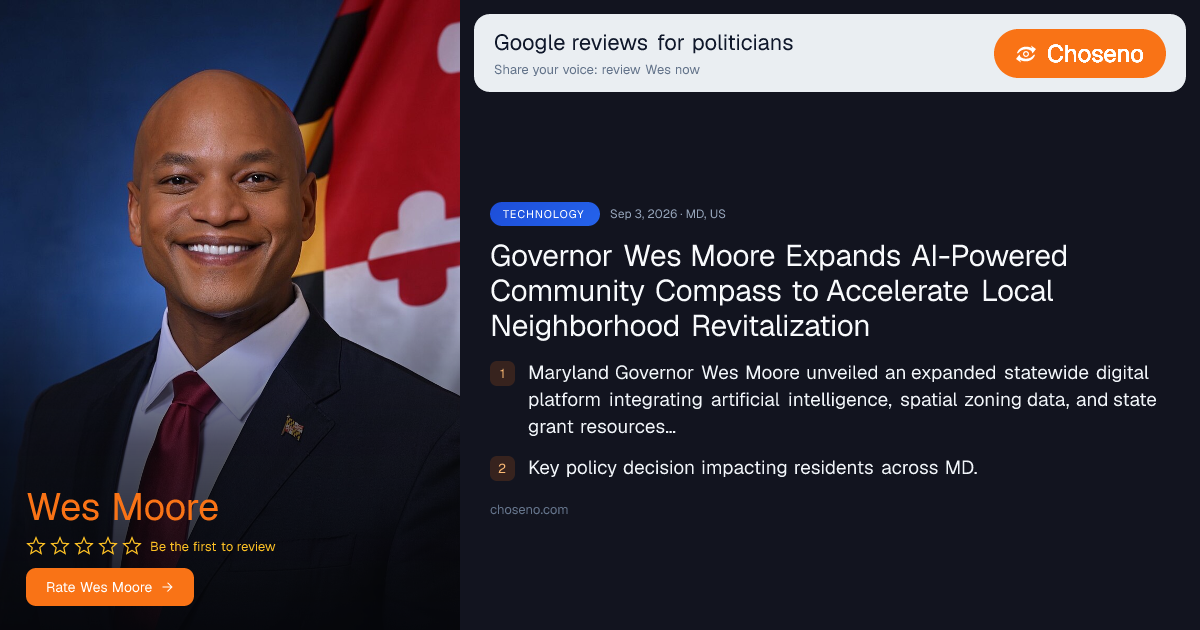
Governor Wes Moore Expands AI-Powered Community Compass to Accelerate Local Neighborhood Revitalization
Maryland Governor Wes Moore unveiled an expanded statewide digital platform integrating artificial intelligence, spatial zoning data, and state grant resources to assist entrepreneurs and local developers revitalizing underserved communities.
Read full article
Technology
US Sep 2, 2026
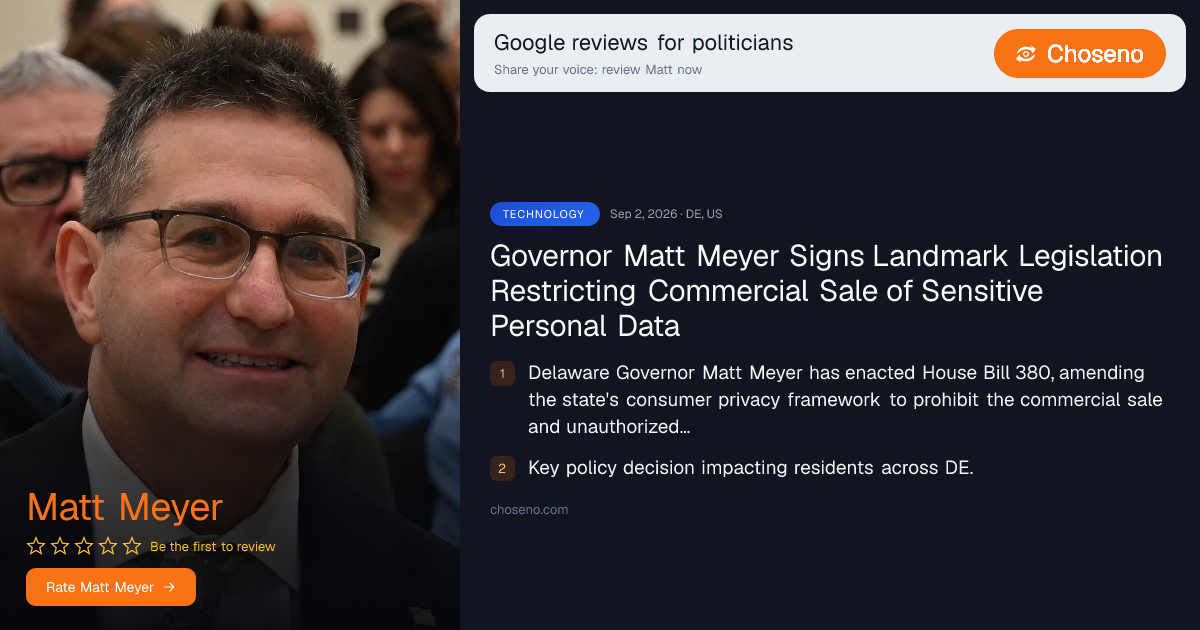
Governor Matt Meyer Signs Landmark Legislation Restricting Commercial Sale of Sensitive Personal Data
Delaware Governor Matt Meyer has enacted House Bill 380, amending the state's consumer privacy framework to prohibit the commercial sale and unauthorized broker transfer of sensitive geolocation, biometric, health, and minors' personal records.
Read full article
Technology
US Aug 31, 2026
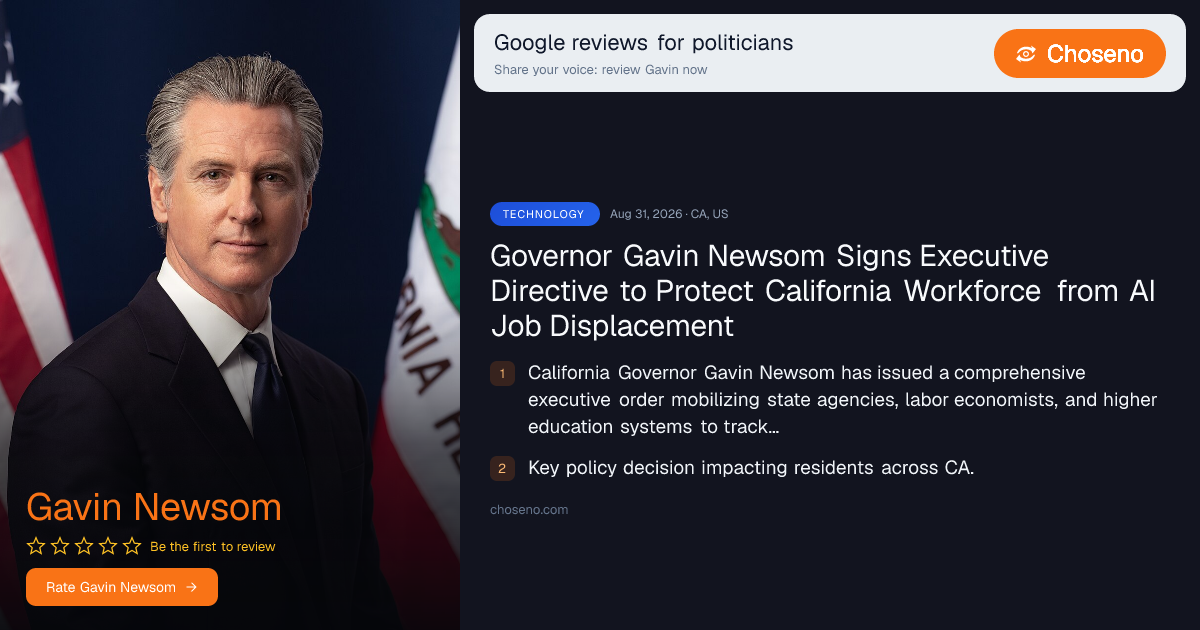
Governor Gavin Newsom Signs Executive Directive to Protect California Workforce from AI Job Displacement
California Governor Gavin Newsom has issued a comprehensive executive order mobilizing state agencies, labor economists, and higher education systems to track artificial intelligence displacement trends. The directive mandates workforce retraining investments, modernized severance standards, and early-warning layoff monitoring across state industries.
Read full article