Ontario Premier Doug Ford Defends ,000 Shoreline Sign Countering White House Great Lakes Order
Taxpayer advocacy groups criticize the provincial government after Premier Doug Ford erects a permanent bilingual sign at Fifty Point Conservation Area following a U.S. federal naming directive.
Choseno Civic News Desk September 4, 2026Updated September 6, 2026 3 min read Ontario, CA
Ontario Premier Doug Ford has drawn scrutiny from taxpayer advocacy organizations following disclosures that the provincial government spent twenty-five thousand dollars to construct and install a prominent shoreline sign affirming the historic name of Lake Ontario. The permanent bilingual installation, unveiled at the Fifty Point Conservation Area in Grimsby along the western shoreline, was erected as a direct diplomatic counter-statement to a United States presidential directive regarding shared international boundary waterways.
The cross-border dispute erupted after the White House issued an executive order directing American federal departments and mapping agencies to refer to Lake Ontario as Lake America across domestic cartographic publications, agency communications, and official federal documentation. In response, Premier Ford held a public press conference on the shores of Lake Ontario in the Niagara region, unveiling a substantial display bearing the message that Lake Ontario retains its ancestral name now and always in both English and French.
Confirmation from the Premier's Office that the fabrication, transportation, and structural installation of the monument cost approximately twenty-five thousand dollars from provincial general revenues drew immediate criticism from fiscal watchdogs. Representatives from the Canadian Taxpayers Federation characterized the expenditure as an unnecessary and symbolic use of public funds, arguing that provincial leadership could have delivered a firm diplomatic response through digital statements or bilateral communication channels without billing taxpayers for outdoor signage.
Provincial opposition lawmakers at Queen's Park echoed concerns regarding government spending priorities, questioning why executive contingency funds were deployed for symbolic cross-border posturing while provincial municipal services, public transit lines, emergency room staffing, and local conservation authorities face ongoing budgetary strain. Critics called on the Ford administration to focus its cross-border diplomatic capital on high-stakes trade barriers, steel and aluminum tariffs, automotive manufacturing rules, and supply chain coordination rather than promotional outdoor installations.
Defending the public expenditure, spokespersons for Premier Ford emphasized that the Great Lakes represent a vital economic corridor, a strategic freshwater reserve, and an essential component of Canadian national sovereignty and provincial identity. The administration maintained that defending Ontario's geographical heritage and international boundaries requires a visible, permanent, and unequivocal public stand against unilateral foreign rebranding efforts that disregard historic international treaties.
Local officials in the Niagara and Hamilton regions noted that Fifty Point Conservation Area attracts hundreds of thousands of domestic visitors and international tourists annually, viewing the installation as an educational focal point celebrating the Great Lakes Water Quality Agreement and the binational stewardship that has governed the waterway under the International Joint Commission for over a century.
Furthermore, community conservation advocates highlighted that maintaining regional recreational access, wetland ecology, and shoreline environmental protections requires ongoing intergovernmental collaboration between provincial ministries, local municipalities, and environmental trusts. The controversy highlights the complex balancing act confronting Canadian provincial leaders as they navigate heightened geopolitical and trade tensions with the United States. While Premier Ford continues to cultivate commercial partnerships with American governors and industrial manufacturers, the sign at Grimsby underscores his administration's willingness to engage in high-visibility public resistance when federal sovereignty and cultural landmarks are contested.
Rate the people mentioned in this article

Related Coverage in governance
See all governance newsgovernance
CA Sep 4, 2026
Emo Township Council Reprimands Mayor Harold McQuaker Over Undisclosed Donated Funds
The municipal council in northwestern Ontario voted unanimously to suspend Mayor Harold McQuaker's pay for 60 days following an integrity commissioner report into personal account deposits.
Read full article

governance
CA Sep 4, 2026
Federal Government Commits .1 Million for National Swine Disease Surveillance at Atlantic Veterinary College
Agri-Food Minister Heath MacDonald announces federal investments in Charlottetown to enhance veterinary diagnostic testing, disease tracking, and biosecurity across Canada's pork sector.
Read full article

governance
CA Sep 2, 2026
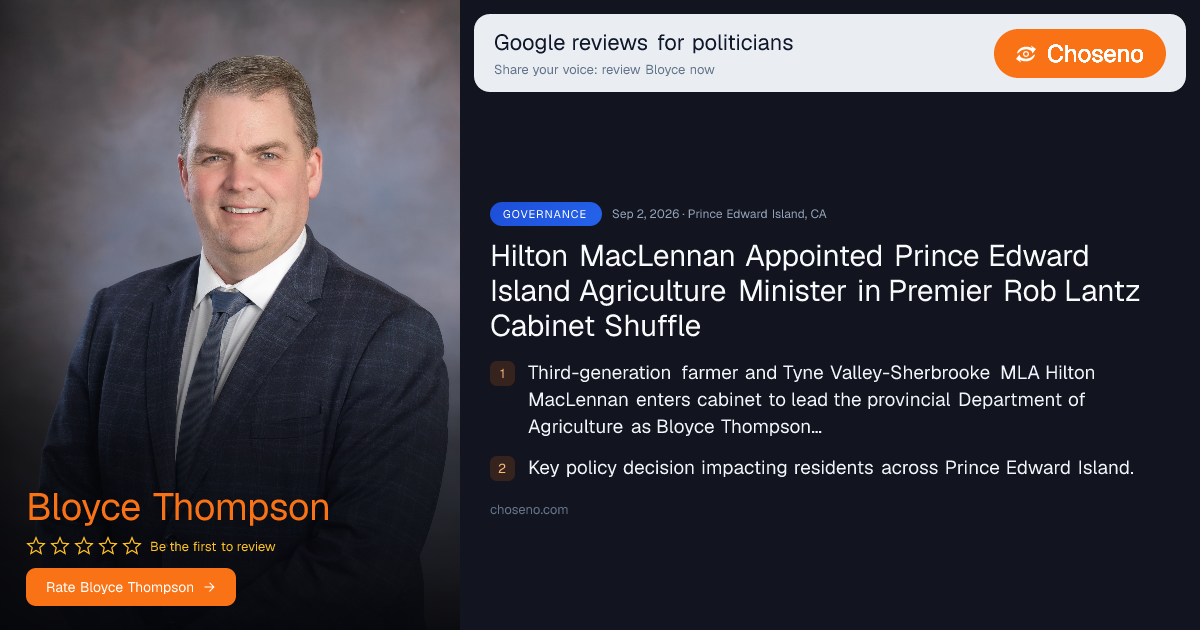
Hilton MacLennan Appointed Prince Edward Island Agriculture Minister in Premier Rob Lantz Cabinet Shuffle
Third-generation farmer and Tyne Valley-Sherbrooke MLA Hilton MacLennan enters cabinet to lead the provincial Department of Agriculture as Bloyce Thompson shifts to justice and infrastructure portfolios.
Read full article