Prime Minister Mark Carney Imposes KPI Progress Reviews on Federal Cabinet Ahead of Policy Retreat
Canadian Prime Minister Mark Carney requires federal cabinet ministers to deliver detailed metrics and performance benchmarks on seven core economic priorities prior to an upcoming retreat.
Choseno Civic News Desk September 4, 2026Updated September 6, 2026 3 min read Ontario, CA
Canadian federal cabinet ministers have been directed to report directly to Prime Minister Mark Carney to deliver comprehensive progress assessments and quantifiable key performance indicators on their ministerial files ahead of an upcoming cabinet retreat. The accountability directive marks a significant operational departure from traditional federal governance conventions, imposing a rigorous managerial evaluation process across all government departments.
Under the framework established by the Prime Minister's Office, ministers are required to demonstrate measurable advancement aligned with the overarching mandate issued to the federal executive. In a notable shift from historical precedent where incoming administrations delivered bespoke, individual mandate letters to each cabinet portfolio, Prime Minister Carney established a single, unified mandate letter binding the entire cabinet. That guiding document prioritized seven overarching national targets, prominently emphasizing interprovincial economic integration—termed \building one Canadian economy\—and direct affordability measures to lower household living costs across the country.
Senior departmental officials and political staff report that the unprecedented evaluation exercise has created intense pressure across ministerial offices. Unlike the traditional autumn pre-budget cycle, during which ministers formulate spending proposals and financial requests for submission to the Treasury Board and Finance Department, the current process operates as an executive-level performance audit. Ministers must articulate specific legislative milestones, regulatory modernizations, and programmatic outcomes achieved under their direction, accompanied by verifiable data points demonstrating tangible impacts for Canadian taxpayers.
The review process is scheduled to unfold over a two-week period in early September 2026, leading directly into a multi-day cabinet retreat where the federal ministry will finalize strategic legislative priorities for the upcoming parliamentary session. Government insiders note that the structured reviews reflect Carney's extensive executive background in central banking and international finance, translating private-sector corporate governance and outcome-based accountability metrics into federal administrative machinery.
Supporters of the centralized performance framework argue that traditional ministerial structures frequently fostered bureaucratic inertia and siloed operations, where departments pursued competing or fragmented objectives with limited cross-agency coordination. By establishing standardized performance benchmarks tied to national economic productivity and cost-of-living reduction, proponents maintain that the administration can accelerate policy execution and ensure ministers remain strictly focused on key electoral commitments during a turbulent global economic climate.
Conversely, political analysts and opposition critics have raised questions regarding the degree of executive centralization implied by the uniform mandate and performance audits. Critics contend that treating cabinet members as departmental managers answering to a chief executive risks diminishing the traditional principle of collective cabinet responsibility and parliamentary discretion. Opposition parliamentarians have argued that rigid key performance indicators may oversimplify complex social and foreign policy portfolios that do not easily translate into mathematical productivity metrics.
The forthcoming retreat will provide the first major test of how this streamlined managerial approach shapes the federal government's policy agenda. Ministers who successfully demonstrate tangible progress on core economic files are expected to see their legislative initiatives prioritized on the government's autumn parliamentary calendar, while lagging files may face administrative restructuring or reallocation of ministerial resources as the government prepares for impending legislative battles in the House of Commons.
Rate the people mentioned in this article

Related Coverage in Governance
See all Governance newsGovernance
US Sep 8, 2026
Governor Gavin Newsom Acknowledges Federal Justice Department Inquiries Concerning Nonprofit Records
California Governor Gavin Newsom has publicly disclosed that federal investigators from the Department of Justice are conducting document and financial inquiries involving him and First Partner Jennifer Siebel Newsom, prompting a fierce dispute over federal oversight impartiality and nonprofit compliance.
Read full article

Governance
US Sep 8, 2026
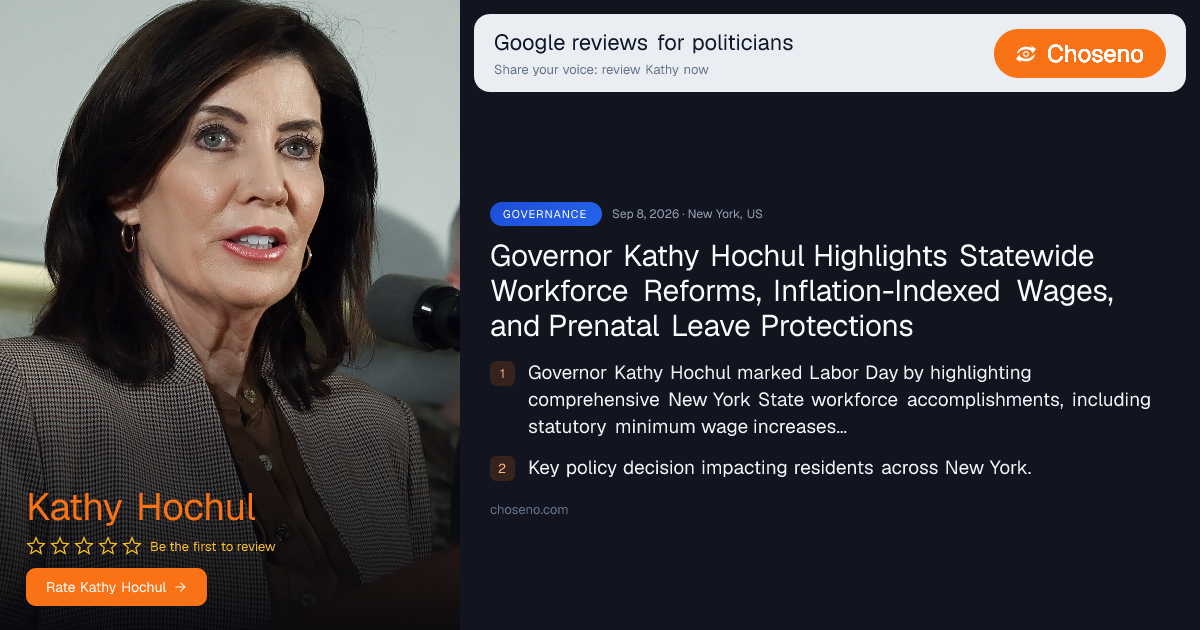
Governor Kathy Hochul Highlights Statewide Workforce Reforms, Inflation-Indexed Wages, and Prenatal Leave Protections
Governor Kathy Hochul marked Labor Day by highlighting comprehensive New York State workforce accomplishments, including statutory minimum wage increases indexed to inflation, implementation of the nation first mandatory paid prenatal leave law, and the full elimination of the state unemployment insurance debt.
Read full article
Governance
US Sep 7, 2026
New Jersey Governor Mikie Sherrill Reaches Agreement With 17 Public Sector Unions Waiving Health Premium Hikes
New Jersey Governor Mikie Sherrill and 17 state employee labor unions have finalized an agreement waiving scheduled 2027 health benefit contribution rate increases and creating an advisory working group to overhaul the State Health Benefits Program.
Read full article