Agriculture Commissioner Sid Miller Urges Governor Abbott to Direct Data Center Contributions to Rural Mental Health
Escalating his critique of rapid artificial intelligence infrastructure expansion, Texas Agriculture Commissioner Sid Miller called on Governor Greg Abbott to donate industry campaign contributions to the state AgriStress Helpline while renewing calls for a special legislative session.
Choseno Civic News Desk September 4, 2026 2 min read TX, US
In an escalating public confrontation between top statewide Republican officials, Texas Agriculture Commissioner Sid Miller has formally called on Governor Greg Abbott to donate any political campaign contributions received from commercial data center developers to the state AgriStress Helpline, reiterating sharp warnings regarding the strain hyperscale computing campuses impose on rural water supplies and the ERCOT electric grid.
Miller, who has emerged as one of the most vocal critics in Austin regarding the unregulated proliferation of energy- and water-intensive artificial intelligence facilities, issued the challenge during regional agricultural remarks in East Texas. The commissioner argued that aggressive corporate lobbying by tech developers has distorted policy priorities in the state capital at the expense of agricultural producers, livestock ranchers, and rural groundwater conservation districts.
If the data center industry has surplus millions to direct into political war chests in Austin, that capital should immediately be redirected to support the men and women who feed and clothe this state, Miller stated. Our rural producers are grappling with prolonged droughts, volatile input costs, and unprecedented competition for baseline water and power resources.
The AgriStress Helpline, administered in partnership with the Texas Department of Agriculture, operates as a confidential, 24/7 crisis support and mental health resource specifically tailored for agricultural workers, ranchers, and rural families experiencing extreme economic stress, disaster displacement, or occupational hardship.
Beyond the campaign donation challenge, Miller renewed his formal request for Governor Abbott to convene an emergency special session of the Texas Legislature ahead of the regular 89th legislative convening in January. Miller contends that waiting months to establish statutory boundaries risks locking in dozens of multi-gigawatt facility agreements that could exhaust local subterranean aquifers and inflate wholesale power transmission costs for residential ratepayers.
Governor Abbott and state economic development officials have vigorously defended the recruitment of major enterprise data centers, describing Texas as the premier global hub for semiconductor fabrication and artificial intelligence computing. The governor office has maintained that capital investments bring billions of dollars in commercial property tax base enhancements to rural school districts and county governments, while ERCOT grid operators implement demand-response protocols to protect overall grid stability.
The public divergence between Abbott and Miller highlights deepening intra-party debates across Sun Belt states, as rural agricultural constituencies increasingly push back against large-scale industrial and technological zoning in unincorporated counties.
Rate the people mentioned in this article

Related Coverage in Agriculture
See all Agriculture newsAgriculture
CA Sep 4, 2026
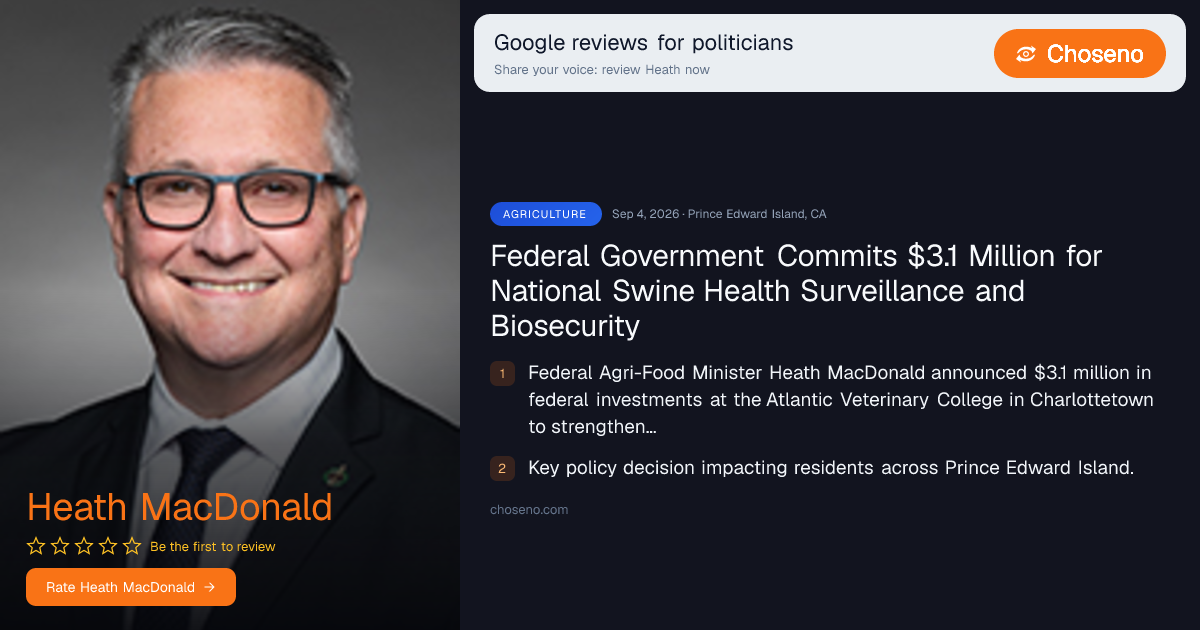
Federal Government Commits $3.1 Million for National Swine Health Surveillance and Biosecurity
Federal Agri-Food Minister Heath MacDonald announced $3.1 million in federal investments at the Atlantic Veterinary College in Charlottetown to strengthen national swine disease tracking, laboratory diagnostics, and biosecurity protections for Canada’s $28-billion pork industry.
Read full article
Agriculture
US Aug 31, 2026
Maryland Farmers Press 2026 Gubernatorial Candidates for Regulatory Relief and Farmland Protections
Facing escalating operational input costs, retaliatory agricultural trade tariffs, and competing solar energy land conversion, Maryland family farm operators across the Eastern Shore and Western Maryland are pressing 2026 gubernatorial candidates for targeted tax relief, commercial vehicle fee exemptions, and enhanced agricultural preservation funding.
Read full article

Agriculture
CA Aug 25, 2026
Premier Danielle Smith Allocates $220 Million for Southern Alberta Irrigation Pipelines
Alberta Premier Danielle Smith and Agriculture Minister RJ Sigurdson allocate $220 million to convert 200 kilometers of open earthen irrigation canals into pressurized subterranean underground pipelines, conserving 150 million cubic meters of agricultural water in Southern Alberta.
Read full article