Arizona Gubernatorial Contest Puts Spotlight on Evolving Priorities of Latter-day Saint Electorate
Choseno Civic News Desk September 7, 2026 3 min read
What do you think of the people in this story? Rate them anonymously — tap a face below.
★ Choseno Civic Briefing
PHOENIX — The evolving political alignment of Arizona’s Latter-day Saint voting bloc has emerged as a central focal point in the state’s gubernatorial contest, where contrasting candidacies are testing traditional partisan loyalties across the American Southwest. With conservative Republican U.S. Representative Andy Biggs and former Mesa Mayor John Giles offering competing political visions rooted in the same faith tradition alongside incumbent Democratic Governor Katie Hobbs, political observers note that the campaign is accelerating a broader demographic and ideological realignment across suburban Maricopa County.
Latter-day Saint voters have historically represented a reliable cornerstone of Arizona’s conservative Republican coalition, particularly across the rapidly growing East Valley municipalities of Mesa, Gilbert, Chandler, and Queen Creek. However, recent statewide election cycles have revealed increasing ideological nuance within the demographic, which comprises approximately six percent of the state’s overall electorate and a decisive share of active primary and general election voters. Political strategists observe that growing numbers of moderate, college-educated, and suburban members express discomfort with hyper-partisan political rhetoric and contentious national polarization, leading to a growing segment of independent or politically uncommitted voters.
Representative Biggs has built his gubernatorial campaign upon a foundation of constitutional conservatism, strict fiscal restraint, and robust border security enforcement, principles that have earned him deep support among party activists and conservative grassroots organizations throughout the state. His legislative record in the United States Congress emphasizes limited federal intervention, deregulation, and strong social conservatism, themes that continue to resonate with traditional conservative church members who view robust institutional limits on government power as essential to personal liberty and economic vitality.
In contrast, former municipal executive John Giles has championed a pragmatist governing philosophy centered on regional infrastructure investments, municipal water conservation agreements, and bipartisan economic development. Having served as mayor of Mesa, home to the state’s oldest and largest Latter-day Saint community, Giles has frequently clashed with nationalized party orthodoxy, arguing that local governance requires pragmatic problem-solving, institutional integrity, and civil discourse rather than ideological polarization. Campaign analysts emphasize that having two prominent members of the faith tradition on the ballot effectively neutralizes shared religious identity as a voting factor, forcing voters to evaluate the candidates based on policy outcomes, ethical standards, and governing temperament.
Incumbent Governor Katie Hobbs and state Democratic organizers are closely monitoring the East Valley dynamics, recognizing that even marginal shifts among suburban LDS voters can decide statewide elections in a battleground determined by razor-thin margins. During her tenure, Governor Hobbs has focused outreach efforts on nonpartisan civic priorities, including public school funding, semiconductor manufacturing expansion, and regional aquifer management, attempting to appeal to independent suburban voters frustrated by contentious national politics.
Sociological and political researchers studying Western religious demographics note that Arizona’s electoral trends mirror wider patterns across the Intermountain West, where younger and suburban LDS voters are increasingly asserting political independence across ballot measures and candidate choices. As the gubernatorial campaign intensifies ahead of the November election, campaign field operations are heavily competing across East Valley precincts, knowing that the choices made by this cohesive yet evolving constituency could ultimately decide the balance of executive power in Arizona.
Rate the people mentioned in this article


Related Coverage in General
See all General newsGeneral
US Sep 25, 2026
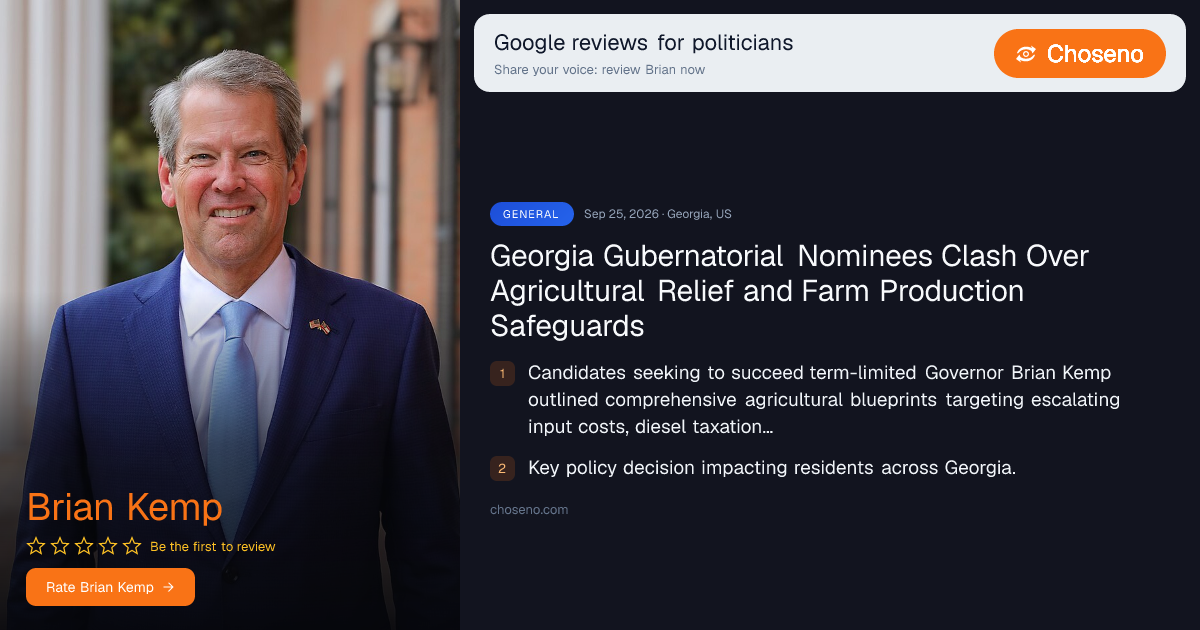
Georgia Gubernatorial Nominees Clash Over Agricultural Relief and Farm Production Safeguards
Candidates seeking to succeed term-limited Governor Brian Kemp outlined comprehensive agricultural blueprints targeting escalating input costs, diesel taxation relief, water allocations, and family farm preservation.
Read full article
General
US Sep 25, 2026
Oregon Gubernatorial Candidates Kotek and Drazan Present Contrasting Economic Platforms in Rematch Forum
Oregon Governor Tina Kotek and Republican challenger Christine Drazan outlined starkly different economic blueprints regarding commercial regulations, tax structures, and industrial competitiveness at a Portland business forum.
Read full article

General
US Sep 25, 2026
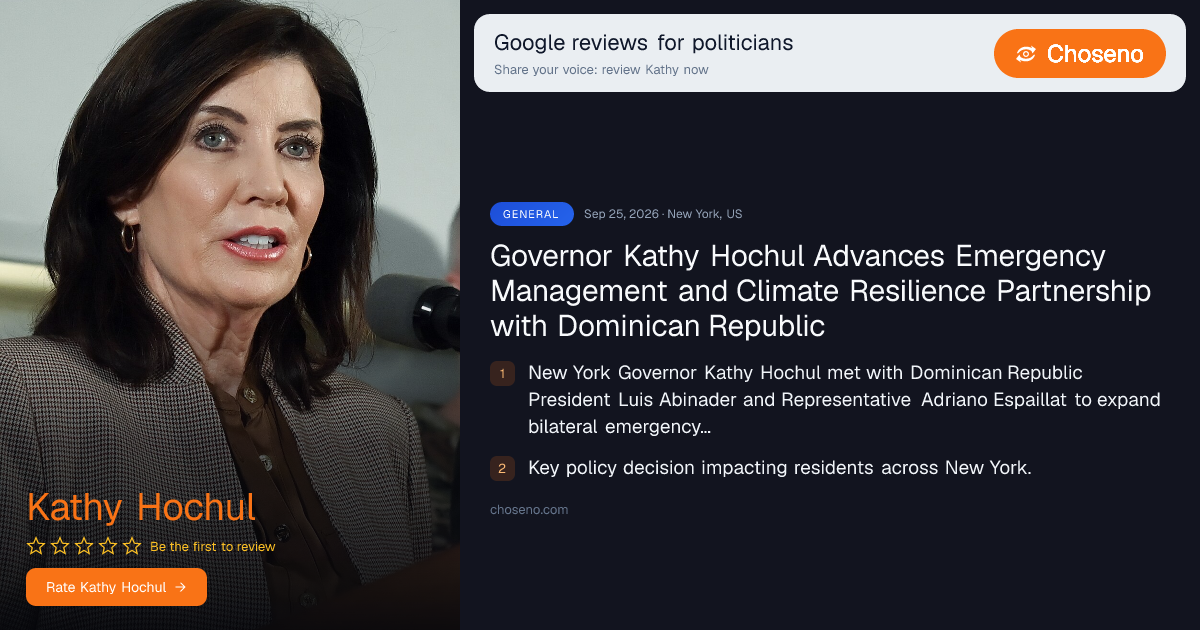
Governor Kathy Hochul Advances Emergency Management and Climate Resilience Partnership with Dominican Republic
New York Governor Kathy Hochul met with Dominican Republic President Luis Abinader and Representative Adriano Espaillat to expand bilateral emergency management cooperation, training exchanges, and environmental resilience.
Read full article