Dallas Mayor Eric Johnson Spotlights Urban Public Safety and Economic Policy Ahead of National Midterm Gathering
Dallas Mayor Eric Johnson is set to highlight municipal public safety, property tax reductions, and urban economic expansion at a national gathering, drawing both praise and debate over City Hall governance.
Choseno Civic News Desk September 6, 2026 3 min read Texas, US
What do you think of the people in this story? Rate them anonymously — tap a face below.
Dallas Mayor Eric Johnson is preparing to address municipal governance, urban economic competitiveness, and law enforcement recruitment at an upcoming national midterm gathering in North Texas, highlighting the city administrative trajectory as the most populous municipality in the United States led by a Republican mayor.
Johnson, a former Democratic state representative who switched his party affiliation to Republican following his reelection to a second mayoral term, has pointed to municipal crime reduction metrics and fiscal conservatism as central tenets of his executive tenure. City Hall administration reports indicate that Dallas has registered steady declines in violent crime over consecutive annual cycles, which the mayor has attributed to sustained investments in frontline police hiring, tactical data-informed policing models, and targeted community intervention initiatives.
The upcoming North Texas civic gathering provides Johnson with a significant platform to showcase Dallas as a major financial and corporate hub while articulating conservative municipal policy frameworks. During recent civic engagements, the mayor underscored that Dallas continues to lower property tax rates while simultaneously financing core infrastructure enhancements and municipal services, presenting the city as an alternative model to urban jurisdictions experiencing budgetary constraints and commercial center out-migration. Municipal finance analysts noted that competitive tax policies combined with major corporate relocations have substantially expanded the regional commercial tax base.
However, Johnson governance record and policy emphasis continue to draw substantive local civic debate across Dallas County. Dallas County Democratic Party Chair Kardal Coleman contended that the mayor political alignment does not accurately reflect the broader ideological makeup of Dallas voters, arguing that municipal achievements reflect collaborative community efforts rather than partisan executive realignment. Furthermore, several members of the Dallas City Council have debated the distribution of executive credit for municipal improvements, with disagreements surfacing over capital expenditure allocations, council deliberative processes, and proposals surrounding the renovation versus replacement of the Dallas City Hall municipal complex.
In addition to City Hall infrastructure debates, municipal leaders are currently navigating implementation priorities for the multi-billion-dollar municipal capital bond program approved by Dallas voters. Council members across several districts have stressed the necessity of equitable fund distribution for neighborhood street repairs, park expansions, flood mitigation systems, and affordable housing preservation, urging that executive visibility on the national political stage should not overshadow day-to-day administrative execution across underserved neighborhoods.
At the national level, Johnson previously established the Republican Mayors Association to expand conservative leadership across urban metropolitan areas, providing fundraising assistance and policy resources to municipal candidates across the country. Academic analysts, including Southern Methodist University political science professor Cal Jillson, noted that as Johnson approaches term limits ahead of the November 2027 Dallas municipal election, his public appearances alongside state leaders, including Governor Greg Abbott, highlight ongoing strategic discussions regarding the future role of conservative executive governance in major American cities.
Former Dallas Mayor Tom Leppert observed that the core strategic objective for the city leadership remains maintaining Dallas status as an economic engine while preserving an open, business-friendly environment capable of drawing diversified capital investments. As national political and municipal leaders convene in Dallas, city administrators, council representatives, and civic watchdogs will closely monitor how executive policy commitments translate into upcoming municipal budget negotiations, police retention targets, and long-term capital improvement projects across the North Texas region.
Rate the people mentioned in this article

Related Coverage in General
See all General newsGeneral
US Sep 25, 2026
Georgia Gubernatorial Nominees Clash Over Agricultural Relief and Farm Production Safeguards
Candidates seeking to succeed term-limited Governor Brian Kemp outlined comprehensive agricultural blueprints targeting escalating input costs, diesel taxation relief, water allocations, and family farm preservation.
Read full article

General
US Sep 25, 2026
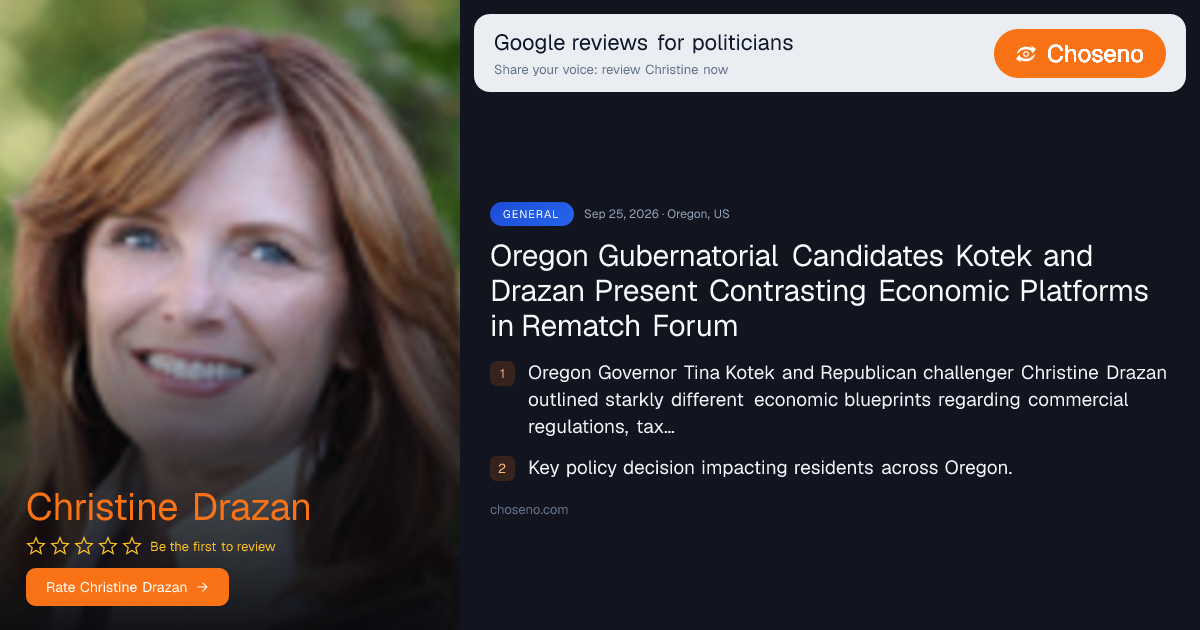
Oregon Gubernatorial Candidates Kotek and Drazan Present Contrasting Economic Platforms in Rematch Forum
Oregon Governor Tina Kotek and Republican challenger Christine Drazan outlined starkly different economic blueprints regarding commercial regulations, tax structures, and industrial competitiveness at a Portland business forum.
Read full article
General
US Sep 25, 2026
Governor Kathy Hochul Advances Emergency Management and Climate Resilience Partnership with Dominican Republic
New York Governor Kathy Hochul met with Dominican Republic President Luis Abinader and Representative Adriano Espaillat to expand bilateral emergency management cooperation, training exchanges, and environmental resilience.
Read full article