Minneapolis Mayor Jacob Frey Proposes Major Reallocation in Municipal Violence Prevention Budget
Minneapolis Mayor Jacob Frey has unveiled budget proposals to reduce municipal funding for contracted community violence interrupters by 2.7 million dollars, redirecting public safety resources toward an expanded, city-administered Community Safety Ambassador initiative.
Choseno Civic News Desk September 7, 2026 3 min read Minnesota, US
Minneapolis Mayor Jacob Frey has initiated a major structural realignment of the city’s public safety budget, proposing to slash two million seven hundred thousand dollars in funding for contracted community-based violence interrupter programs. Under the Mayor’s executive budget recommendations presented to the Minneapolis City Council, the city would redirect public safety capital into an expanded, municipally administered Community Safety Ambassador program, setting up a contentious legislative debate over accountability, contract oversight, and crime prevention strategies across the city.
Under the executive proposal, the annual municipal allocation for independent violence interruption contracts would be reduced to approximately eight hundred thousand dollars, requiring non-profit vendors to compete for a significantly curtailed pool of city funds. Concurrently, Mayor Frey proposed investing an additional two million three hundred thousand dollars to transition the Downtown and neighborhood Community Safety Ambassador initiative into a permanently staffed, city-managed operation under the direct oversight of the Minneapolis Office of Community Safety.
In defending the budgetary reallocation, Mayor Frey characterized violence interruption as a well-intentioned initiative staffed by dedicated grassroots leaders, but maintained that external contractor models have failed to demonstrate the verifiable, data-driven outcomes demanded by municipal taxpayers. The Mayor highlighted administrative audits and compliance reviews that identified persistent deficiencies in performance tracking, financial recordkeeping, and operational oversight, pointing to pending legal proceedings involving alleged fiscal mismanagement by external service providers. Frey argued that executive stewardship requires directing public dollars toward programs that demonstrate direct, measurable reductions in street-level disturbances and commercial corridor disruptions.
The proposed reallocation unfolds as the city continues to navigate acute staffing shortages within the Minneapolis Police Department, which remains well below authorized sworn officer benchmarks. To compensate for reduced patrol ranks, the Frey administration has sought to expand alternative uniformed municipal presences that handle non-violent quality-of-life complaints, support commercial district safety, and coordinate directly with behavioral crisis response teams. Officials maintain that bringing safety ambassadors directly onto the municipal payroll ensures standardized training, consistent oversight, and clear lines of administrative accountability across all municipal wards.
However, the proposed reductions have encountered fierce resistance from community organizations, street outreach workers, and progressive members of the Minneapolis City Council. Leaders from community groups, including T.O.U.C.H. Outreach, argued that reducing city investment threatens to dismantle delicate, hard-won relationships forged by credible messengers who mediate gang disputes, de-escalate volatile conflicts, and steer vulnerable youth away from retaliatory gun violence. Community advocates contended that evaluating violence interruption purely through short-term administrative metrics overlooks the preventative, life-saving impact of non-police community engagement.
City Council members, including Ward 9 representative Jason Chavez, voiced strong opposition to the Mayor’s proposal, warning that curtailing frontline community outreach would destabilize commercial corridors in south and north Minneapolis that continue to grapple with persistent violent crime. Council progressive leaders indicated that they will introduce budget amendments to restore violence interruption appropriations during upcoming legislative committee markup sessions.
As the City Council begins public hearings on the municipal budget, the battle over violence interruption funding will test the political balance of power between Mayor Frey and progressive council members over the future of urban safety governance.
Rate the people mentioned in this article

Related Coverage in General
See all General newsGeneral
US Sep 25, 2026
Georgia Gubernatorial Nominees Clash Over Agricultural Relief and Farm Production Safeguards
Candidates seeking to succeed term-limited Governor Brian Kemp outlined comprehensive agricultural blueprints targeting escalating input costs, diesel taxation relief, water allocations, and family farm preservation.
Read full article

General
US Sep 25, 2026
Oregon Gubernatorial Candidates Kotek and Drazan Present Contrasting Economic Platforms in Rematch Forum
Oregon Governor Tina Kotek and Republican challenger Christine Drazan outlined starkly different economic blueprints regarding commercial regulations, tax structures, and industrial competitiveness at a Portland business forum.
Read full article

General
US Sep 25, 2026
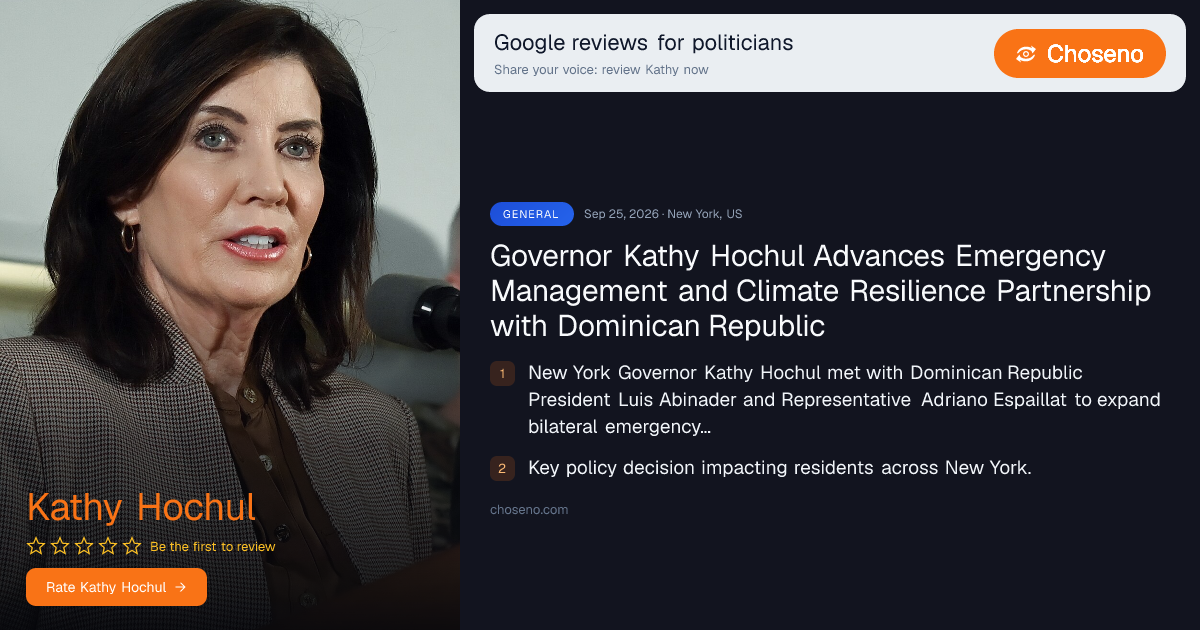
Governor Kathy Hochul Advances Emergency Management and Climate Resilience Partnership with Dominican Republic
New York Governor Kathy Hochul met with Dominican Republic President Luis Abinader and Representative Adriano Espaillat to expand bilateral emergency management cooperation, training exchanges, and environmental resilience.
Read full article