Ontario Premier Doug Ford Clarifies Municipal Stance as Toronto Mayoral Candidates Debate Provincial Relations
Ontario Premier Doug Ford clarified that the provincial government will maintain formal neutrality in the upcoming Toronto mayoral election, as candidates debate transit funding, uploading agreements, and fiscal independence.
Choseno Civic News Desk September 25, 2026 3 min read Ontario, CA
Ontario Premier Doug Ford reaffirmed that the provincial government will maintain strict institutional neutrality in the upcoming Toronto mayoral election, clarifying earlier public comments that had prompted widespread speculation regarding an informal executive endorsement of incumbent Mayor Olivia Chow. Following remarks at a joint commercial biomanufacturing announcement where the premier commended city administration and advised observers to read between the lines, the Premier Office issued a formal administrative clarification confirming that the province does not endorse candidates in municipal elections. Provincial officials emphasized that the premier and cabinet ministers stand ready to collaborate constructively with whichever municipal leadership team Toronto voters elect to Queen Park.
The clarification arrived as municipal challengers engaged in sharp debates regarding the financial and administrative relationship between Canada largest municipality and the provincial government. Challenger Brad Bradford and other mayoral contenders criticized the optics of the premier remarks, arguing that city leadership must maintain robust fiscal independence rather than relying upon informal political arrangements with provincial leadership. Challengers pointed out that key municipal files, including persistent operating deficits, property assessment modernization, and provincial uploading agreements for highways, require rigorous and transparent intergovernmental negotiations rather than personalized political understandings.
Incumbent Mayor Olivia Chow defended the administrative record of municipal-provincial cooperation, pointing to substantial joint capital investments achieved under the historic New Deal for Toronto agreement enacted during her tenure. City hall financial administrators emphasized that the bilateral framework successfully transferred ongoing financial and maintenance responsibilities for the Gardiner Expressway and Don Valley Parkway to the province, saving municipal property taxpayers billions of dollars in long-term capital repair costs. The mayor maintained that maintaining productive working partnerships with provincial authorities delivers tangible infrastructure benefits for municipal transit riders and working families.
Municipal governance analysts and urban planning researchers at the University of Toronto observed that mayoral candidates are seeking institutional funding commitments and regulatory certainty from the province rather than personal political endorsements. Experts noted that prospective mayors require clear provincial commitments on subsidized housing construction, mental health outreach funding, and predictable operating subsidies for the Toronto Transit Commission. Analysts pointed out that escalating municipal service pressures make sustainable provincial transfers indispensable for municipal fiscal stability, irrespective of ideological differences between City Hall and Queen Park.
Business associations and commercial leaders across the Greater Toronto Area emphasized that stable provincial-municipal relations are essential to sustain economic productivity and commercial competitiveness. Board of trade representatives pointed out that traffic congestion, transit line construction delays, and regional housing shortages require coordinated regional planning rather than adversarial posturing between municipal councils and provincial ministries. Commercial stakeholders urged all mayoral hopefuls to prioritize collaborative regional infrastructure development to maintain Toronto standing as a global financial and commercial hub.
With the Toronto municipal general election scheduled for late October, candidates are intensifying campaign stops across the city core and inner suburbs. Premier Ford affirmed that the provincial administration remains dedicated to advancing mutual economic priorities, ensuring transit system expansion, and supporting community safety initiatives across Toronto while respecting the democratic prerogative of municipal voters to determine their local leadership.
Topics
Related Coverage in General
See all General newsGeneral
US Sep 25, 2026
Georgia Gubernatorial Nominees Clash Over Agricultural Relief and Farm Production Safeguards
Candidates seeking to succeed term-limited Governor Brian Kemp outlined comprehensive agricultural blueprints targeting escalating input costs, diesel taxation relief, water allocations, and family farm preservation.
Read full article
General
US Sep 25, 2026
Oregon Gubernatorial Candidates Kotek and Drazan Present Contrasting Economic Platforms in Rematch Forum
Oregon Governor Tina Kotek and Republican challenger Christine Drazan outlined starkly different economic blueprints regarding commercial regulations, tax structures, and industrial competitiveness at a Portland business forum.
Read full article
General
US Sep 25, 2026
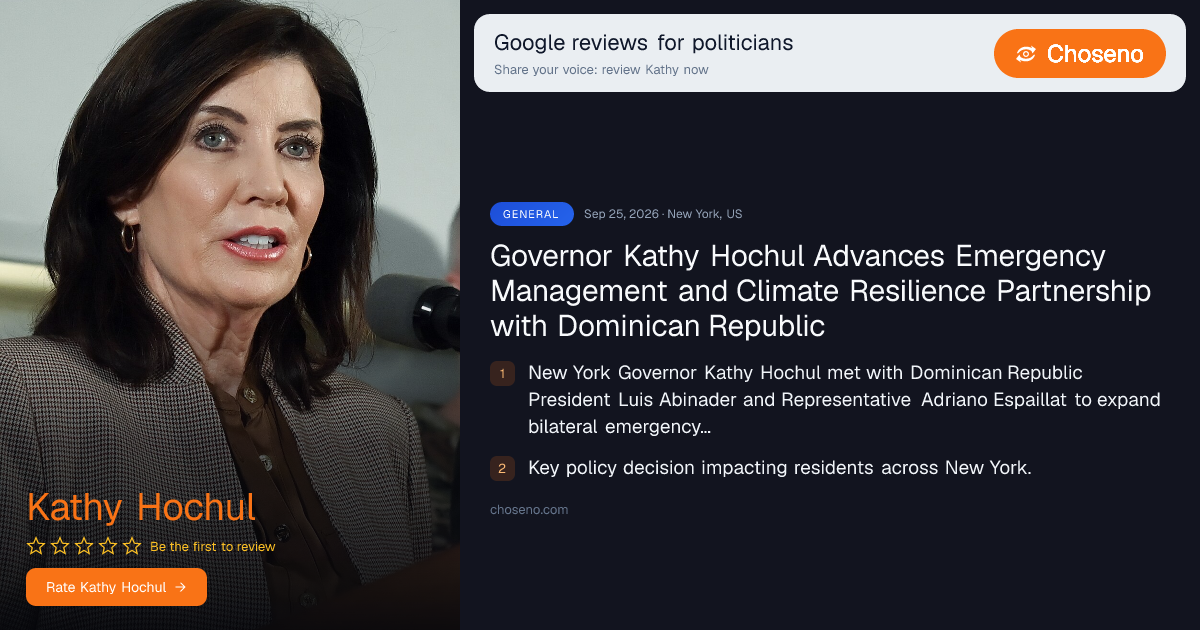
Governor Kathy Hochul Advances Emergency Management and Climate Resilience Partnership with Dominican Republic
New York Governor Kathy Hochul met with Dominican Republic President Luis Abinader and Representative Adriano Espaillat to expand bilateral emergency management cooperation, training exchanges, and environmental resilience.
Read full article