Wisconsin Gubernatorial Candidates Offer Contrasting Fiscal Visions for Three Billion Dollar State Surplus
In the 2026 Wisconsin gubernatorial contest, Republican U.S. Representative Tom Tiffany and Democratic Milwaukee County Executive David Crowley have staked out starkly differing positions on how to deploy an estimated three billion dollar state budget surplus, highlighting fundamental divisions over tax relief and public service investments.
Choseno Civic News Desk September 7, 2026 3 min read Wisconsin, US
What do you think of the people in this story? Rate them anonymously — tap a face below.
A projected state budget surplus of approximately three billion dollars has emerged as a central dividing line in the 2026 Wisconsin gubernatorial campaign, underscoring fundamentally divergent governing philosophies between Republican nominee Tom Tiffany and Democratic nominee David Crowley. As voters prepare to choose the successor to outgoing executive leadership, the substantial reserve fund has ignited sharp debate over whether surplus tax revenues should be entirely returned to households or allocated toward strained municipal infrastructure, healthcare delivery, and primary education across the state.
Republican nominee Tom Tiffany, currently serving in the United States House of Representatives representing northern Wisconsin, has anchored his campaign platform to an aggressive program of fiscal retrenchment. Tiffany has repeatedly argued that any sustained accumulation of excess state revenue demonstrates that taxpayers have been overcharged by government authorities. Under his proposed economic blueprint, titled Keep More of Your Hard-Earned Money, Tiffany has pledged to return the entirety of the three billion dollar surplus to Wisconsin residents through comprehensive tax reductions. His proposal pairs this refund strategy with an across-the-board ten percent personal income tax cut for families earning less than one hundred and fifty thousand dollars annually, the complete elimination of state income levies on tips and overtime pay, and a statutory freeze on municipal property taxes.
By contrast, Democratic nominee David Crowley, who serves as Milwaukee County Executive, has framed the state surplus as a generational opportunity to stabilize essential public institutions while addressing systemic cost-of-living pressures across urban and rural communities. While acknowledging the broad financial squeeze experienced by working families, Crowley has cautioned that draining the entire reserve fund for immediate tax rebates would leave school districts, regional hospitals, and local public transit networks vulnerable to severe recurring deficits. Crowley has advocated using surplus revenues to directly bolster state funding formulas for K-12 public education, expand affordable healthcare initiatives, and provide targeted property tax relief directly to homeowners and small commercial property holders.
The legislative trajectory of Wisconsin’s surplus has heightened partisan friction throughout the current cycle. Earlier in the year, a bipartisan compromise negotiated within the state legislature that aimed to pair targeted tax rebates with supplemental appropriations for public school districts ultimately collapsed in the state Senate. Governor Tony Evers subsequently attributed the breakdown of that bipartisan measure to political interventions by federal lawmakers, including Tiffany, who had urged legislative conservatives to reject compromise agreements in favor of sweeping tax repeals.
The divergent approaches have prompted sharp exchanges on the campaign trail. The Tiffany campaign has focused extensive criticism on Crowley’s executive tenure in Milwaukee County, characterizing regional spending decisions as fiscally undisciplined and pointing to local sales and property tax adjustments approved to prevent municipal insolvency. Conversely, Crowley and his allies have characterized Tiffany’s platform as reckless, asserting that eliminating state revenues on such a massive scale would inevitably force deep cuts to Medicaid funding, public safety grants, and environmental oversight programs.
With both nominees presenting distinct fiscal architectures, Wisconsin voters face a consequential choice between an administration centered on broad tax reductions and one focused on targeted public investments and municipal stabilization throughout the state.
Rate the people mentioned in this article

Related Coverage in General
See all General newsGeneral
US Sep 25, 2026
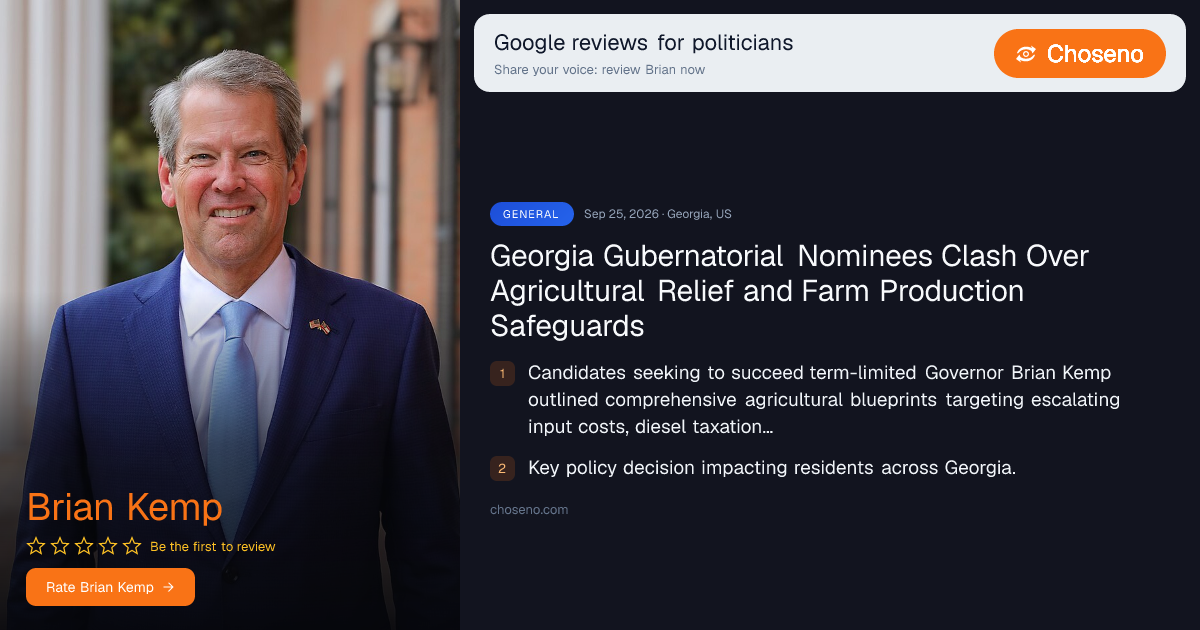
Georgia Gubernatorial Nominees Clash Over Agricultural Relief and Farm Production Safeguards
Candidates seeking to succeed term-limited Governor Brian Kemp outlined comprehensive agricultural blueprints targeting escalating input costs, diesel taxation relief, water allocations, and family farm preservation.
Read full article
General
US Sep 25, 2026
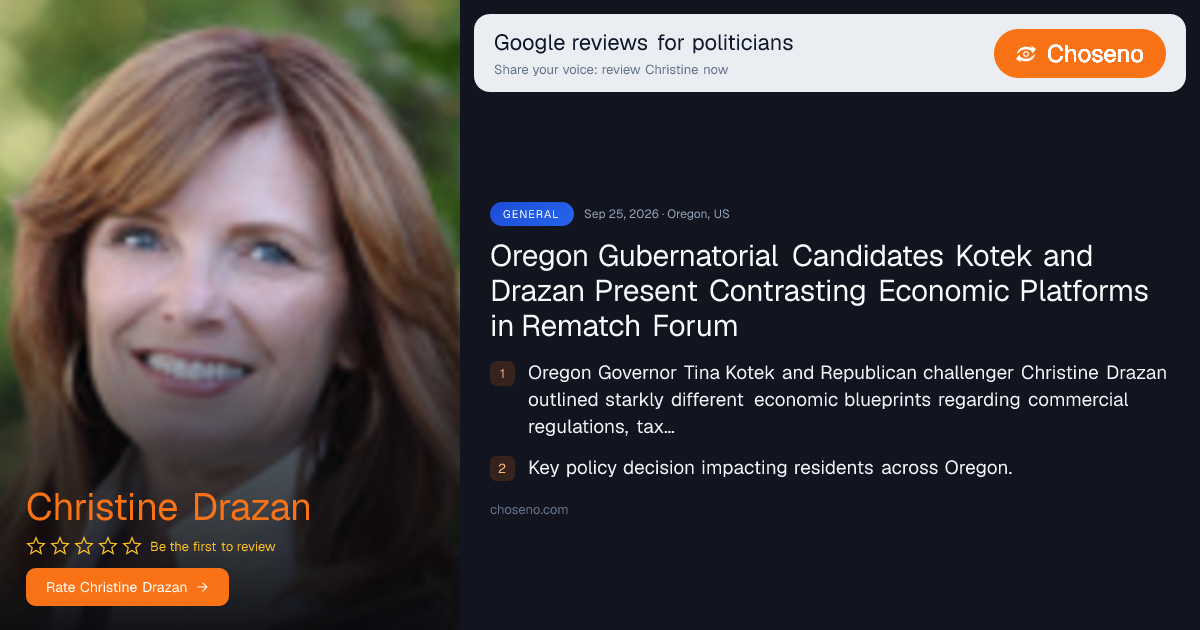
Oregon Gubernatorial Candidates Kotek and Drazan Present Contrasting Economic Platforms in Rematch Forum
Oregon Governor Tina Kotek and Republican challenger Christine Drazan outlined starkly different economic blueprints regarding commercial regulations, tax structures, and industrial competitiveness at a Portland business forum.
Read full article
General
US Sep 25, 2026
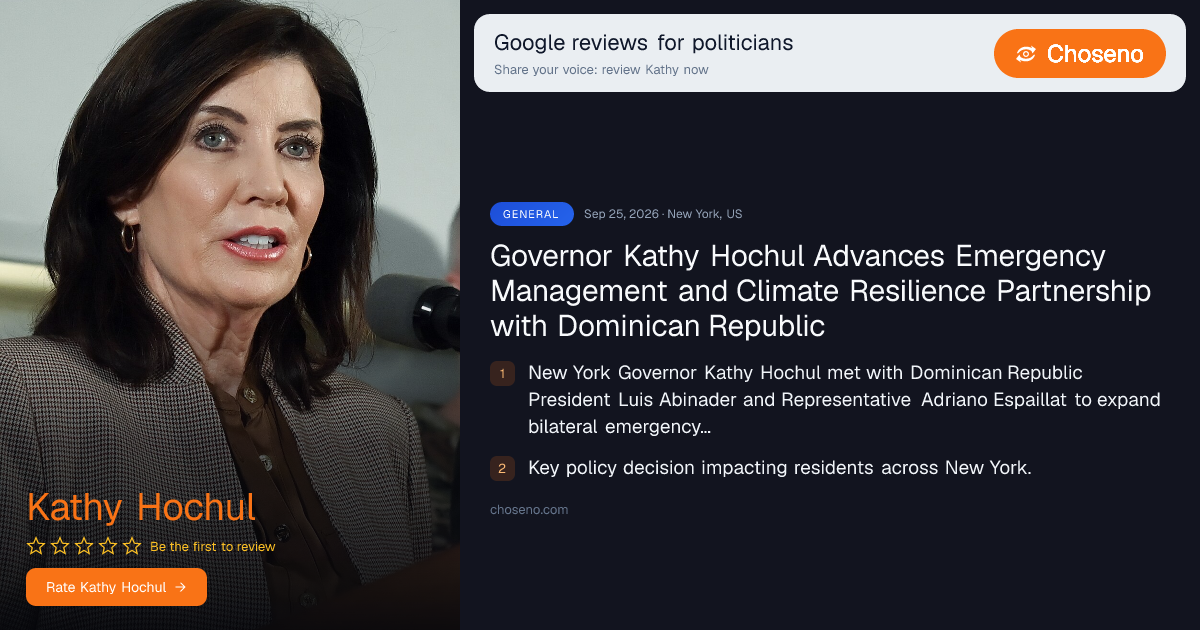
Governor Kathy Hochul Advances Emergency Management and Climate Resilience Partnership with Dominican Republic
New York Governor Kathy Hochul met with Dominican Republic President Luis Abinader and Representative Adriano Espaillat to expand bilateral emergency management cooperation, training exchanges, and environmental resilience.
Read full article