Premier David Eby Warns Snap Election Decides British Columbia Sovereignty Amid Cross-Border Trade Tensions
British Columbia Premier David Eby escalated campaign rhetoric ahead of the October general election, arguing that opposition political alignments risk subordinating provincial policy to United States commercial influence.
Choseno Civic News Desk September 25, 2026 3 min read British Columbia, CA
What do you think of the people in this story? Rate them anonymously — tap a face below.
British Columbia Premier David Eby escalated campaign rhetoric during regional speaking appearances across the Lower Mainland, asserting that the upcoming provincial snap election represents a foundational choice between defending provincial economic sovereignty or allowing conservative opposition alignments to reduce British Columbia to an economic protectorate of the United States. Speaking to unionized building trades and civic organizers, the New Democratic Party leader argued that trade protectionism and aggressive tariff policies emanating from Washington require an unyielding provincial government capable of protecting public healthcare, natural resource corridors, and union manufacturing jobs. The premier pointed to political messaging from conservative candidates as evidence of a willingness to accommodate cross-border economic pressure at the expense of domestic workers.
The premier remarks center heavily on controversies surrounding conservative opposition figures who previously shared social media maps depicting western Canadian provinces operating under formal American protectorate status within a proposed regional trade federation. Premier Eby asserted that interim Conservative leader Lorne Doerkson and party organizers have failed to repudiate extreme fringe elements within their legislative caucus, warning that electing an administration sympathetic to external political movements would facilitate private healthcare expansion, environmental deregulation, and the erosion of provincial supply management frameworks. The premier argued that conservative economic proposals emulate American commercial models that dismantle public services, degrade environmental standards, and worsen wealth inequality.
Opposition Conservative leadership firmly rejected the premier characterizations, describing the remarks as desperate political fearmongering designed to distract voters from the governing administration record on housing affordability, taxation, and municipal crime. Interim leader Lorne Doerkson asserted that British Columbia Conservatives are fully committed to Canadian federalism and provincial autonomy, emphasizing that expanding private sector investment and eliminating provincial carbon levies does not compromise sovereign governance. Opposition spokespersons accused the premier of manufacturing foreign political threats to justify calling a cynical snap election two years ahead of the statutory provincial schedule.
Political scientists and electoral analysts at Simon Fraser University observed that the premier focus on cross-border political dynamics reflects a calculated campaign strategy to nationalize the provincial election. Analysts pointed out that with recent public opinion surveys showing the Conservatives holding competitive leads in suburban ridings across the Fraser Valley, the New Democratic Party is seeking to frame the ballot question around international resilience and leadership stability rather than localized discontent over healthcare wait times and consumer inflation.
Business associations and international trade experts urged political parties to maintain focus on pragmatic economic solutions, pointing out that British Columbia deep commercial integration with Pacific Northwest states requires constructive cross-border diplomacy. Trade economists noted that while protecting domestic forestry and clean technology sectors is essential, provincial leaders must navigate bilateral trade relationships carefully to avoid provoking retaliatory tariffs from American trade authorities that could paralyze provincial export corridors.
Premier Eby affirmed that his campaign will continue to highlight the contrasting visions for the province, maintaining that British Columbians deserve a government that fiercely protects domestic resource sovereignty, expands public healthcare infrastructure, and defends working families during uncertain global economic times across North America.
Both campaigns plan intensive weekend bus tours across competitive interior ridings, where resource extraction policies, carbon taxation, and local hospital staffing remain the paramount issues dominating voter forums.
Topics
Rate the people mentioned in this article


Related Coverage in General
See all General newsGeneral
US Sep 25, 2026
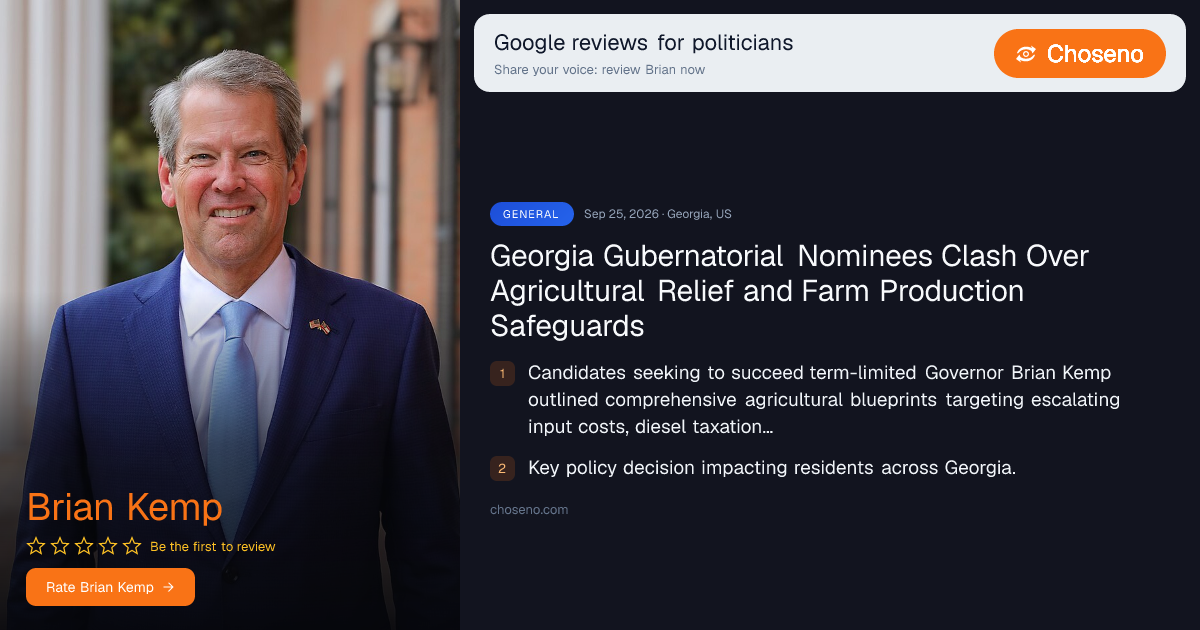
Georgia Gubernatorial Nominees Clash Over Agricultural Relief and Farm Production Safeguards
Candidates seeking to succeed term-limited Governor Brian Kemp outlined comprehensive agricultural blueprints targeting escalating input costs, diesel taxation relief, water allocations, and family farm preservation.
Read full article
General
US Sep 25, 2026
Oregon Gubernatorial Candidates Kotek and Drazan Present Contrasting Economic Platforms in Rematch Forum
Oregon Governor Tina Kotek and Republican challenger Christine Drazan outlined starkly different economic blueprints regarding commercial regulations, tax structures, and industrial competitiveness at a Portland business forum.
Read full article
General
US Sep 25, 2026
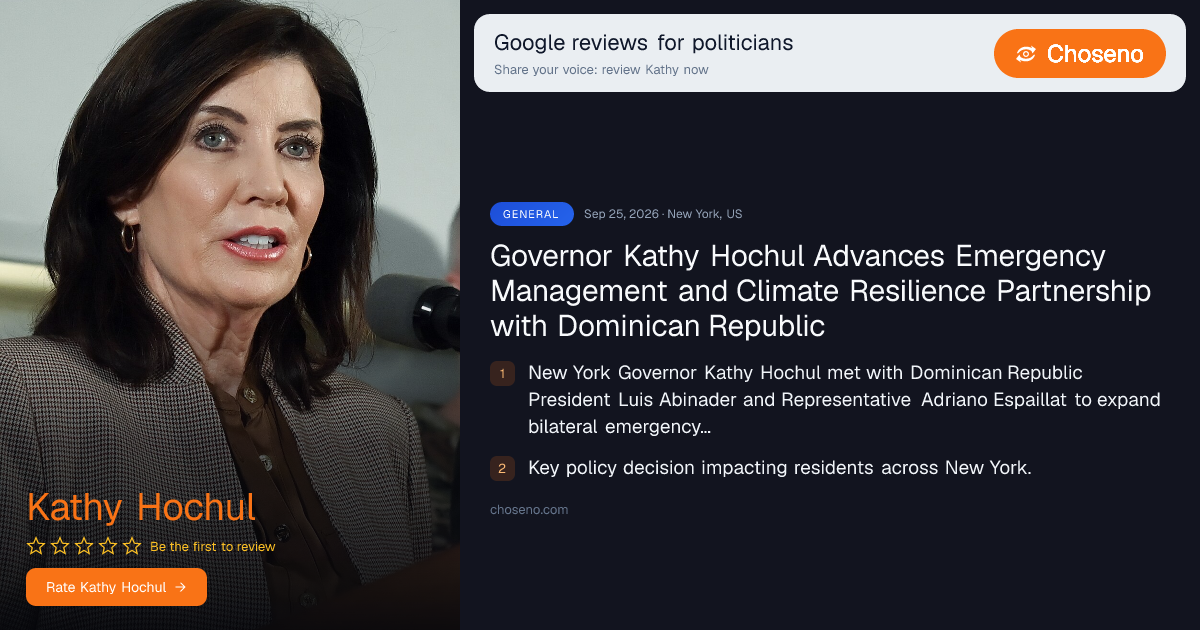
Governor Kathy Hochul Advances Emergency Management and Climate Resilience Partnership with Dominican Republic
New York Governor Kathy Hochul met with Dominican Republic President Luis Abinader and Representative Adriano Espaillat to expand bilateral emergency management cooperation, training exchanges, and environmental resilience.
Read full article