BC Election 2026: Where the NDP, Conservatives, Greens and New Parties Stand
Twenty-nine days into B.C.'s snap election, with advance voting under way, here's what the NDP, Conservatives, Greens, CentreBC and OneBC have pledged on taxes, health care, housing, child care, farmland and costing — updated Oct. 20.
Choseno Civic News Desk September 27, 2026Updated October 20, 2026 35 min read BC, CA
What do you think of the people in this story? Rate them anonymously — tap a face below.
VICTORIA, B.C. — Updated Oct. 20, 2026 — It's day twenty-nine of British Columbia's snap election. Advance voting is under way and voting day is Saturday, Oct. 24. The only televised leaders' debate took place Oct. 14. The Conservatives released a costed platform on Oct. 18, so the NDP and CentreBC now also have costed plans, and the polls show a close race. Dollar figures and savings estimates below are the parties' own claims.
Where each party stands today
BC NDP (David Eby)
Higher taxes on top earners to pay for health care, and a focus on affordability.
- A new 24.5% bracket on income over $1 million and higher rates above $190,405 (2027).
- Health care: a Public Health Care Guarantee, 8 more MRIs and 10 CT scanners, 20 new primary care clinics.
- Cost of living: 10-cent fuel tax cut, grocery margin cap, ICBC rates frozen until 2030.
- Crime: 50 more Crown prosecutors and double the repeat-offender programs. Surrey: $250 million for bus rapid transit and a free bus pass for 350,000 low-income seniors.
- Housing and child care: a $390 million affordable housing call, and $80 million for 7,200 before- and after-school spaces plus a promised child-care fee cap. It has not said it would lift the freeze on new $10-a-day spaces.
BC Conservatives (Lorne Doerkson, interim)
No new taxes, a tax cut, and a tougher approach to crime and drugs.
- First positions on farmland (remap and reform the ALR) and child care (independent providers eligible for new $10-a-day spaces), and a $500 children's activity credit.
- Raise the basic personal exemption to $32,000 (up to $1,000 a year). Its costed platform (Oct. 18) shows tax cuts totalling $11.3 billion by 2030 and a deficit of $10.8 billion by 2030.
- 250 more police and 500 more RCMP officers, end "safe supply," and mandatory treatment.
- Repeal DRIPA and SOGI 123; double LNG production by 2032.
- Keep current health funding, plus a $50 million rural emergency fund and a guarantee of treatment by another provider when wait benchmarks are missed. Replace the Massey tunnel with a 10-lane bridge. The NDP says the costing relies on unrealistic growth.
BC Greens (Emily Lowan)
Tax extreme wealth to pay for public services.
- A one-time wealth tax above $50 million (party estimate $22.2 billion), then an annual one.
- Free child care for all families by 2031 and lift the freeze on new $10-a-day spaces.
- A community health centre in every riding, six MSP-covered mental-health visits a year, 26,000 affordable homes a year.
- Oppose new pipelines and LNG expansion; decriminalize personal drug possession.
CentreBC (Elenore Sturko)
Published a full, costed platform (44 pages) on Oct. 12.
- Cut the first income-tax bracket to 5.06% and raise the renter's credit to $600.
- Balance the budget by 2034/35; a family doctor or nurse practitioner team for everyone by 2031.
- 20,000 new $10-a-day child-care spaces; 500 more RCMP officers.
OneBC (Dallas Brodie, interim)
Deep tax cuts and the hardest line on DRIPA and drugs.
- Cut every personal and corporate tax bracket by 25% and take 2 points off the PST.
- Repeal DRIPA and the Indian Act; remove SOGI 123.
- End safe supply, involuntary rehab; allow private health care alongside public.
Side by side
| Issue | NDP | Conservatives | Greens | CentreBC | OneBC |
|---|---|---|---|---|---|
| Taxes | Higher rates over $190K; 24.5% over $1M | No new taxes; $1,000 cut | Wealth tax over $50M | Cut first bracket to 5.06% | Cut all brackets 25% |
| Health care | Care guarantee; 8 MRIs, 10 CTs; 20 clinics | Hold funding; $50M rural ER fund | Health centre in every riding | Family doctor for all by 2031 | Private care alongside public |
| Housing | Tax on empty condos; $390M affordable housing call | Cut construction taxes; keep foreign buyers tax | 26,000 homes a year; vacancy control | Permits in 8 weeks | Scrap Step Code; block rent control |
| Cost of living | 10¢ fuel tax cut; grocery margin cap | No PST on Canadian alcohol | Welfare to poverty line | Renter credit to $600 | Cut PST by 2 points |
| Child care | Fee cap and school-age spaces; no pledge to lift freeze | Independent providers in $10-a-day; no fee-cap position | Free by 2031; lift freeze | 20,000 $10-a-day spaces | None found |
| Crime and drugs | 50 more prosecutors; double repeat-offender programs | 250 police, 500 RCMP; mandatory treatment | Decriminalize; regulated supply | +500 RCMP, +60 prosecutors | End safe supply; involuntary rehab |
| Energy | LNG, critical minerals; tanker ban | Double LNG by 2032; Pacific Link | Against LNG expansion and pipelines | General: resources plus green tech | Oil pipeline |
| DRIPA | Unclear | Repeal | No position found | None found | Repeal |
| Budget | Shrink deficit; no date | Deficit to $10.8B by 2030 (party plan) | Fund by taxing wealth | Balance by 2034/35 | Balance in 4 years |
| ICBC | Keep no-fault; freeze to 2030 | Hybrid; ICBC stays public option | None found | None found | None found |
| SOGI 123 | Ended ARC funding | Repeal | Keep | Keep protections | Repeal |
The race right now
- Polls: The Conservatives lead every poll, by 2 to 5 points. Leger (Oct. 9–12) has them at 42% to the NDP's 40%, Research Co. (Oct. 9–11) 44% to 42%, and Ipsos (Oct. 7–11) 43% to 38%. The Greens are at 8% to 11%. About one in four voters is undecided. No poll fielded after the Oct. 14 debate had been published as of Oct. 19.
- Final stretch: The Conservatives released their costed platform on Oct. 18, and Eby has been asking Green voters to back the NDP to keep the Conservatives out. Eby's family use of a $10-a-day child-care spot, and Conservative candidates' social-media posts, have also been in the news.
- Debate (Oct. 14): Eby, Doerkson and Lowan clashed on costing, DRIPA, housing and candidates' posts. Eby and Lowan faulted the Conservatives for not yet having a costed platform. The leaders of CentreBC and OneBC were not included.
- Voting: Advance voting runs Oct. 16–21, 8 a.m. to 8 p.m., at any advance voting place in B.C. Voting day is Oct. 24. You must be a Canadian citizen, 18 or older, and a B.C. resident since April 23, and you'll need ID showing your name and address. Municipal elections were a separate vote on Oct. 17.
Each party's stand in detail
BC NDP (David Eby)
- Taxes and cost of living: The new top bracket (24.5% over $1 million) and higher rates on income from $190,405 to $1 million, from 2027; the NDP projects $1 billion a year by 2028/29 and says over 96% of residents would pay nothing more. A 10-cent-per-litre fuel tax cut and a pump-price "price guard," a grocery margin cap (up to $700 a year in savings, the NDP says), and basic ICBC rates frozen until spring 2030.
- Housing: A tax on unsold finished condos (2%, rising 1 point a year), a vacancy tax of 2% for domestic and 5% for foreign owners, and (Oct. 18) a $390 million call for non-market projects, 30-day permit decisions for builds of up to six units ($5 million a year to help municipalities), up to 50% off development cost charges (pending a federal agreement) and doubling the homes protected by the BC Rental Protection Fund.
- Health care: The Public Health Care Guarantee, 8 MRIs and 10 CTs, 20 more primary care clinics and 1,000 training seats, 500 more home-care workers, a free shingles vaccine for adults 50 and older, and a women's health plan.
- Economy: A $500 million small-business tariff and wildfire relief fund, a $5,000 youth hiring credit, and double critical-minerals exports within five years.
- Involuntary care (Oct. 16): Up to $90 million to set up involuntary care for people with severe mental health and addictions challenges at the Okanagan Correctional Centre in Oliver.
- Public safety (Oct. 14): 50 more Crown prosecutors and double the repeat-offender programs, which can currently monitor as many as 870 people.
- Transit (Oct. 15, Surrey): $250 million to leverage federal money for bus rapid transit on King George Boulevard, a free seniors' bus pass for 350,000 low-income seniors, and a Surrey Charter giving the city Vancouver-style powers.
- Child care (Oct. 17): $80 million for 7,200 new before- and after-school spaces on school grounds, $250 million in new provincial money to leverage federal funding for an early-childhood-educator wage grid and more affordable spaces, and a "hard, universal fee cap like Ontario." The release does not say the freeze on new $10-a-day spaces would be lifted.
- Unclear: DRIPA. The NDP says its new costing plan is paid for by the top-earner tax and economic growth.
BC Conservatives (Lorne Doerkson, interim leader)
- Taxes: "No new taxes" for the term; raise the basic personal exemption from $13,216 to $32,000; no PST on Canadian alcohol while the trade war lasts; no PST on business machinery, equipment and software for three years. None of these was costed.
- Public safety: 250 more police, 500 more RCMP officers and 150 civilian staff over five years, 50 Crown prosecutors, end "safe supply," and mandatory treatment through Mental Health Act changes. An Oct. 13 anti-extortion plan restates 1,000 more police, prosecutors and support staff.
- Health and seniors: Keep current funding, a $50 million rural emergency fund, a 100-day wait-times commission; reverse the NDP's property-tax-deferment changes and build more long-term care beds.
- Energy and economy: Double LNG by 2032 and triple it by 2035, a 120-day permitting law, and red tape cut back to 2017 levels.
- Costed platform (Oct. 18): Tax cuts totalling $11.3 billion by 2030, about $1.42 billion a year in new operating spending, a deficit that shrinks to $10.8 billion by 2030, $2.6 billion in new revenue from growth, and roughly $1.8 billion from a core spending review plus $2 billion from a hiring freeze and attrition. It assumes GDP growth of 2.5% in 2027 and 3.2% in 2029 and a 15% increase in gas production; the NDP calls it full of "shell games" and "wildly unrealistic growth projections."
- NDP response (Oct. 19): The NDP says the $2 billion a year the Conservatives take from the contingencies envelope is a "backdoor healthcare cut," that the $280 million cost of removing the PST on Canadian alcohol is left out, and that the $500 million machinery PST estimate is too low. These are the NDP's claims.
- Platform positions (Oct. 18): A "Universal Health-Care Guarantee" of publicly funded treatment by another qualified provider when surgical wait benchmarks are missed; restart seven shelved long-term care homes (about $1.43 billion); repeal CleanBC; add $100 a month to disability assistance and lift the single-person earnings exemption to $30,000; expand drug courts. On farmland, remap the ALR with modern soil technology, put food security first in the ALR Act, restore "merit-based" Land Commission rulings and aim for 10% less reliance on imported food by 2030. On child care, make independent providers eligible for new $10-a-day spaces as the program expands.
- Thriving Kids (Oct. 19): A refundable credit of up to $500 per child a year for sports, arts and camps, doubling the playground equipment program to $10 million a year, a school phone ban, expanded school meals in high-need communities and an extended Autism Funding Program.
- Roads and hospitals (Oct. 15): Scrap the Massey tunnel replacement and build a 10-lane bridge, finish the Cloverdale hospital and build a new Surrey women's and children's hospital. No cost estimate was given.
- Insurance: A "hybrid" ICBC system that preserves no-fault for most claims and gives catastrophically injured people legal representation with capped fees, with ICBC kept as a public option. The NDP says this would double rates; the Conservatives dispute that.
- Other: Repeal DRIPA and SOGI 123. No child-care fee-cap position and no housing-supply plan yet; Doerkson said at the debate he would keep the foreign buyers tax and the speculation and vacancy tax.
BC Greens (Emily Lowan)
- Taxes: The Fair Share Act: a one-time tax on net wealth of 5% above $50 million, 10% above $100 million and 20% above $1 billion, then an annual tax of 2%, 3% and 5%. The party estimates $22.2 billion in year one and $5.4 billion a year after. Also 50% of net profits from oil and gas royalties.
- Housing and child care: 26,000 affordable homes a year, vacancy control; lift the pause on new $10-a-day spaces and make child care free by 2031.
- Health and seniors: A community health centre in every riding, safe nurse ratios, higher SAFER rent supplements for seniors.
- Environment and economy: Oppose Pacific Link and LNG expansion, 35% of energy from electricity by 2035, forestry reform and a ban on glyphosate, a pause on AI data centres.
- Drugs, mental health and poverty: Decriminalize personal possession with regulated alternatives; (Oct. 17) bring the Mental Health Act into compliance with the Constitution, add a mental-health option to 911 and cover six visits a year to a mental-health professional under MSP; raise welfare and disability rates to the poverty line.
- Education and transit: One counsellor per 250 students, a universal school food program; fully fund transit with free transit for under-25s and those 65 and older.
CentreBC (Elenore Sturko, 1 MLA)
- Costed platform (Oct. 12): 44 pages, released before the Conservatives' and the NDP's; the NDP disputes its numbers.
- Taxes: The first bracket from 5.6% to 5.06% on Jan. 1, 2027 (about $540 a year for a two-income family); renter's credit from $400 to $600.
- Budget: Balanced by 2034/35, with the deficit falling to about $9.0 billion by 2030/31 (party plan).
- Health and safety: A family doctor or nurse practitioner team for everyone by 2031; 500 more RCMP officers and 60 more Crown prosecutors.
- Housing, child care and transit: Rezoning in six months and building permits in eight weeks by 2028; 20,000 new $10-a-day spaces by 2030; 15% more transit service by 2030.
OneBC (Dallas Brodie, interim)
- Taxes: Cut every personal and corporate bracket by 25% and the PST by two points.
- DRIPA and Indigenous policy: Repeal DRIPA and push to repeal the Indian Act. Says it is "the only party that will repeal DRIPA."
- Health and housing: Private health care alongside public care; scrap the Step Code and block municipal rent control.
- Drugs and schools: End safe supply and consumption sites, involuntary rehab, remove SOGI 123.
- Energy: An oil pipeline to the north coast.
- Campaign: Running 33 candidates, including against some Conservative incumbents, which raises the risk of vote-splitting on the right.
More details
All polls so far
- Leger (Oct. 9–12, released Oct. 14): Conservatives 42%, NDP 40%, Greens 9%, OneBC 4%, CentreBC 3%.
- Pallas Data (Oct. 10–11, released Oct. 13): Conservatives 43.4%, NDP 38.1%, Greens 11.2%, OneBC 4.7%, CentreBC 1.5%.
- Ipsos (Oct. 7–11, released Oct. 13): Conservatives 43%, NDP 38%, Greens 11%, OneBC 4%, CentreBC 2% among decided voters; 25% were undecided or had no preference, and 50% said it is time for another party to take over. Eby leads on best premier (30% to Doerkson's 19%).
- Research Co. (Oct. 9–11, released Oct. 13): Conservatives 44%, NDP 42%, Greens 8%, CentreBC 2%, OneBC 2% among decided voters, with 15% undecided (808 likely voters). Eby leads as best premier, 36% to Doerkson's 25%, and 60% are unhappy about the early election.
- Liaison Strategies (Oct. 7–8, released Oct. 9): Conservatives 43%, NDP 37%, Greens 10%, OneBC 4%, CentreBC 3% among decided and leaning voters (1,000 adults, margin of error ±3.1 points). Eby's approval fell to 34% from 38%, with 48% disapproving.
- Pollara (Sept. 23–30, released Oct. 5): NDP 38%, Conservatives 38%, Greens 13%, OneBC 5%, CentreBC 4%. It surveyed 3,017 adults.
- Angus Reid (Oct. 1–3): Conservatives 48%, NDP 43%, Greens 7%. Cost of living is the top issue (57%), then health care (42%). Doerkson edges Eby as best premier, 36% to 33%.
- Mainstreet Research (released Oct. 6): Conservatives 44.7%, NDP 37.2%, Greens 11.2%, OneBC 5.7%, CentreBC 1.1%. It found 59.3% disapprove of the early election.
- Ipsos (Sept. 25–29): Conservatives 42%, NDP 40%, Greens 10%, with 27% undecided.
- Innovative Research (Sept. 25–28): NDP 41%, Conservatives 39%.
- Leger (Sept. 24–28): Conservatives 39%, NDP 36%, Greens 13%. In the same poll 57% disapproved of the early election.
- Liaison (Sept. 26–27): Conservatives 40%, NDP 39%.
- Angus Reid (Sept. 22–24): Conservatives 43%, NDP 35%.
Seat projection (not a poll): The Writ's Oct. 7 update projects the Conservatives at 47 seats and the NDP at 44, with the Greens holding their two seats and the two vote shares about a point apart.
Candidates and the campaign trail
Nominations closed Oct. 3 with 335 candidates in 93 ridings: Conservatives 93, NDP 92 (none in Peace River North), Greens 73, CentreBC 35 and OneBC 33, plus small parties and 15 independents.
- Conservative campaign director controversy (Oct. 11–13): The BC Muslim Association and the National Council of Canadian Muslims called for campaign director Katy Merrifield's removal over past social-media posts about Islam, and Eby urged Doerkson to act. Merrifield said she took the original post down within hours and that her anger was aimed at extremism. As of Oct. 13 morning, Doerkson had not publicly responded, according to reporting.
- Eby and child care (Oct. 12): Eby confirmed at a Delta campaign stop that his family has used the $10-a-day program. In a statement he said one of his children attended a centre that was later designated a $10-a-day site, that the family chose to donate the discount to the centre, and that they will do the same for their youngest child.
- Conservative candidates dropped: The party dropped Victoria-Beacon Hill candidate Joachim Agou on Oct. 8 and Vancouver-Strathcona candidate Jordan McIntosh on Oct. 15 over social-media posts. The party said neither would sit in its caucus if elected.
- Conservative candidate Mike Hicks (Oct. 16): The First Nations Leadership Council condemned remarks by Hicks, the Juan de Fuca–Malahat candidate, that First Nations had to be "conquered," made at a local election debate, and asked him and the party to retract them.
- Key dates: Oct. 16–21 advance voting (8 a.m. to 8 p.m.); Oct. 24 voting day.
Full announcement list: BC NDP
The NDP is running mainly on standing up to Trump, warning that a Conservative government would bring cuts and private health care. Eby has pointed to the Conservatives having had "four leaders in ten months."
Taxes and cost of living
- Income tax (Oct. 4): A new 24.5% bracket on income over $1 million, plus 18.8% on income from $190,405 to $265,545 and 22.5% from $265,545 to $1 million, starting in the 2027 tax year. The NDP projects $225 million in 2026/27, $925 million in 2027/28 and $1 billion in 2028/29, and says over 96% of residents (those making $190,000 or less) would pay nothing more.
- Groceries (Oct. 2, Kelowna): A "price guard" capping retail margins at corporate chains on milk, eggs, cheese, butter and poultry, plus per-unit pricing, a ban on anti-competitive grocery real-estate deals and AI "surveillance pricing," and an independent food terminal in the Lower Mainland. The NDP says it could save up to $700 a year.
- Auto insurance (Oct. 8, Richmond): Freeze basic ICBC rates for three more years, until spring 2030, after years of frozen rates. The NDP says the average driver would save about $500 a year, and that a Conservative "hybrid" system would raise premiums. Asked about the cost, Eby pointed to ICBC's reserves.
- Gas (Oct. 1): A temporary 10-cent-per-litre cut to the provincial motor fuel tax, plus a permanent "price guard" where the B.C. Utilities Commission sets a maximum pump price. The NDP says a two-car family would save up to $100 a month; the tax cut would cost about $250 million.
- Context: Global News noted Eby's 2024 promise of a $1,000 household grocery rebate was later dropped. Eby claims B.C. has "the lowest taxes of any province"; critics note Alberta's lack of a provincial sales tax gives it a lower overall burden.
Housing
- A tax on finished condos left unsold for more than a year, starting at 2% and rising 1 point a year. Eby's office estimates it could unlock about 5,000 empty Metro Vancouver units.
- The speculation and vacancy tax would rise to 2% for domestic owners and 5% for foreign owners.
- A separate federal-provincial plan would buy over 2,220 vacant units for affordable housing.
Health care
- Seniors' care (Oct. 5): 500 more home-care workers to support about 5,600 more seniors at home; free two-dose shingles vaccine for adults 50 and older and immunocompromised adults; restart seven paused long-term care projects; bring 5,000 care-home workers back into the public health employer system.
- Oak Bay Lodge (Oct. 5): $90 million to redevelop the former Victoria site as a seniors' care and community health hub.
- Wait times (Oct. 6, Coquitlam): Eight new MRI machines (including the first at Eagle Ridge Hospital), 10 new CT scanners, coordinated regional surgical waitlists, robotic-assisted surgery, and a "BC Health Passport" app to track referrals and wait times.
- Public Health Care Guarantee (Oct. 12): A pledge signed by every NDP candidate to oppose out-of-pocket charges for medically necessary care and "queue-jumping by those who can pay," and to resist changes that draw staff and funding out of the public system. The NDP also released audio of Conservative health critic Anna Kindy discussing user-pay care; the Conservatives call the NDP's campaign "fearmongering" and point to Doerkson's Oct. 5 commitment to a publicly funded system.
- Women's health (Oct. 13): A first-of-its-kind perinatal mental health unit at B.C. Women's Hospital, PharmaCare coverage of menopause treatments for breast cancer survivors who can't use hormone therapy, pharmacist prescribing for some recurring UTI and menopause symptoms, and a province-wide women's health strategy.
- Primary care (Oct. 9, Surrey): Build 20 more team-based primary care clinics, aim for same-day, evening and weekend appointments through incentives (an "appointment in 24 hours" goal), fast-track international medical graduates already in B.C. through a "bridging to practice" program, and add 1,000 training seats for nurses, nurse practitioners, allied health workers and care aides, including a 20% increase in nursing seats.
- Recruiting: Triple the U.S. health-worker recruitment budget to $15 million, aiming for over 2,400 hires, with loan forgiveness and moving help.
Economy and energy
- Back LNG Canada's Phase 2 expansion in Kitimat, the North Coast Transmission Line, ports and trades training under a "Build B.C. Strong" push.
- Double critical-minerals exports within five years and put $5 million into Prince Rupert cruise-ship infrastructure (Sept. 28).
- Small business (Oct. 7, Surrey): A $500 million Small Business Tariff & Wildfire Relief Fund offering interest-free loans of up to $1 million, repayable over up to 72 months, for businesses hurt by U.S. tariffs or this summer's wildfires; a $5,000 refundable tax credit for small businesses that hire someone aged 18 to 30 into a first full-time, 12-month job; and $6 million a year for market research, advice and help selling to non-U.S. markets.
Wildfire and community safety
- Wildfire (Oct. 2, Summerland): Match Canadian Red Cross donations up to $20 million for this summer's wildfire victims, especially uninsured and underinsured households, and help rebuild public infrastructure.
- Security (Oct. 5): $500,000 a year for three years for the Western Jewish Community Security Network, and a province-wide police summit on extremist activity.
Climate, ferries and regional projects
- Climate and nature (Oct. 10, Courtenay): $30 million a year for the BC Watershed Security Fund, a $50 million starting investment in a Clean Futures Fund drawing on new oil and gas revenue, $50 million to turn old-growth deferrals into permanent protections and help mills use second-growth wood, plus 30-by-30 land protection and water standards for AI data centres.
- Ferries (Oct. 10): A pilot holding 12% of advance reservation capacity for local residents on the Horseshoe Bay–Langdale and Westview–Little River routes.
- Kelowna airport (Oct. 13): $20 million over four years to extend services to undeveloped land at Kelowna International Airport. The NDP claims it would generate about $1 billion in economic activity.
Culture (Oct. 7)
- $15 million toward a permanent Filipino Cultural Centre if re-elected. The NDP did not name a site or host city. The Conservatives pledged the same amount to the same centre earlier on Oct. 7.
Libraries (Oct. 7, Courtenay)
- Permanently double provincial funding for B.C.'s 71 library systems, from $14 million to $28 million a year. The NDP says base funding has been frozen at $14 million since 2010.
Still unclear
- ICBC: The NDP says it would keep no-fault auto insurance and has attacked Doerkson's letter as a "secret deal" (see the Conservatives section).
- Child care (Oct. 12): Eby confirmed at a Delta campaign stop that his family has used the $10-a-day program. In a statement he said one of his children attended a centre that was later designated a $10-a-day site, that the family chose to donate the discount to the centre instead, and that they will do the same for their youngest child. The Conservatives called it "shocking." The NDP has not pledged to lift Budget 2026's pause on new $10-a-day spaces, and says B.C. and Ottawa will negotiate a new child-care funding agreement.
- DRIPA: The NDP backed off amending the Indigenous rights law after First Nations objected, and Eby hasn't said what he'd do now.
- Other areas: No detailed pledges yet on public safety, education or climate.
Full announcement list: BC Conservatives
Kerry-Lynne Findlay resigned as leader on Sept. 20 after 13 of her MLAs quit or were expelled. Days later, Surrey South MLA Brent Chapman left the caucus for OneBC. Doerkson says a full financial platform is coming soon.
Taxes and the budget
- No new taxes: Doerkson pledged on Sept. 27 not to raise existing taxes or bring in new ones, "not once." That comes against a projected $13.8 billion provincial deficit.
- Tax cut (Oct. 8, Surrey): Raise the basic personal exemption from $13,216 to $32,000. The party says that would save up to $1,000 a year for nearly every working person and about $2,000 for the average couple, and that full-time minimum-wage workers would pay no provincial income tax. The party released no costing, and the NDP says it would cost billions of dollars a year.
- Alcohol: Remove the PST on Canadian-made beer, wine and spirits for as long as the U.S. trade war lasts (Sept. 29).
- Deficit: He wants a balanced budget "immediately" through deregulation and productivity rather than cuts, but has said he doesn't yet know the path.
Public safety and drugs (Oct. 6, "Safe Streets for BC")
The party's first detailed 2026 crime and drugs plan:
- Hire 250 more police officers by expanding the JIBC Police Academy.
- Add 500 RCMP officers and 150 civilian staff over five years for rural and regional communities.
- Hire 50 Crown prosecutors, work with Ottawa to fund 20 more trial judges, and add sheriff and court capacity.
- Amend the Mental Health Act so police can connect people with mandatory treatment.
- End the NDP's "safe supply" and expand naloxone access.
Business and the economy (Oct. 7, Surrey)
- Remove the PST on investment in machinery, equipment and business software for three years.
- Cut red tape back to 2017 levels by the end of a first term, with a "one-in, two-out" law and a Minister for Red Tape Reduction.
- A panel to deliver a plan within 180 days to simplify B.C. taxes, and a 120-day permitting act for major projects over $250 million.
- The release gave no costing, and the NDP criticized the plan for lacking cost and job estimates.
ICBC and auto insurance (Oct. 6)
- A Sept. 29 letter signed by Doerkson, made public by the MoveUP union, was addressed to the Insurance Bureau of Canada, the Trial Lawyers Association, the Law Society and the CBA's B.C. branch. It commits a Conservative government to legislation in its first year to restore the right to sue for serious injuries under a hybrid system, and says opening auto insurance to private competition is "on the table."
- Party plan page (Oct. 7): The Conservatives published their position: a hybrid system that cuts most litigation and legal costs while giving seriously injured people access to representation, more consumer choice where competition can improve price and service, and ICBC kept as a public insurance option. No cost or premium estimate was given.
- Doerkson defended the letter in Surrey on Oct. 7, saying it was "meant to be anything but private" and promising rates would stay in line.
- Eby called it a "secret deal" and the NDP and MoveUP say it would double rates (their claim, citing a 2022 Ernst & Young comparison). The Conservatives reject that and say insurance would stay affordable. No Conservative premium estimate has been released.
Youth jobs and ferries (Oct. 10–11)
- First Job Tax Credit (Oct. 10): A credit for businesses that hire young people for a first job. The release gave no amount, eligibility rules or costing.
- BC Ferries (Oct. 11): A BC Ferries Charter setting standards for reliability, on-time performance, capacity, affordability and service, board restructuring, negotiating Ottawa's share of ferry funding, and Wi-Fi on major routes through private procurement with "no new burden on fares or taxpayers."
Seniors (Oct. 9)
- Reverse the NDP's changes to the Property Tax Deferment Program.
- Build more long-term care beds by cutting design rules, and give waiting seniors portable public funding to choose among qualified providers.
- Expand publicly funded home care that seniors direct themselves, and grow HandyDART where demand is greatest.
- Free shingles vaccine, help for low-income seniors to afford hearing aids, and tougher penalties for abuse and fraud against seniors.
- The releases gave no costing.
Health care (Oct. 5, 100 Mile House)
- Keep current funding and a publicly funded system; keep emergency rooms and maternity wards open.
- A $50 million emergency fund for rural care, doctors and nurses.
- Train more doctors in B.C. and speed up international credential recognition.
- An expert commission on wait times within the first 100 days.
Energy and resources
- BC Energy Superpower Plan: More than double LNG and natural gas production by 2032 and more than triple it by 2035, with a 120-day permitting law and the Montney formation treated as a strategic asset. The NDP calls it "out of step with reality."
- Pacific Link pipeline (Oct. 1): Welcomed Ottawa's national-interest designation and backs a second pipeline from northern Alberta to B.C.'s southern coast.
Wildfire (Oct. 2, Summerland)
- Buy new firefighting aircraft including waterbombers (about $400 million, per Revelstoke Review reporting), a $100 million early-detection fund, fuel reduction around communities, and easier prescribed burns.
Other
- Filipino Cultural Centre (Oct. 7): $15 million toward building the centre in Vancouver, which the party says would unlock $15 million in federal matching funds (a party claim).
- Metro Vancouver (Oct. 5): Refocus it on drinking water and sewage, return housing, economic development, air quality and climate policy to local and provincial governments, shrink the board, and audit the North Shore Wastewater Treatment Plant.
- DRIPA: Repealing it is his "top priority," replaced by direct partnerships with First Nations. The party's Oct. 7 plan page says DRIPA "must be repealed."
- Schools: Repeal SOGI in public schools.
- Trump: He'd keep American liquor off B.C. shelves unless the U.S. "gives something in return."
- Child care: The Conservatives' platform chair said the party has "not established a fee cap presently," as quoted by the NDP.
- Campaign director controversy (Oct. 11–13): The BC Muslim Association and the National Council of Canadian Muslims called for campaign director Katy Merrifield's removal over past social-media posts about Islam, and Eby urged Doerkson to act. Merrifield said she took the original post down within hours and that her anger was aimed at extremism. As of Oct. 13 morning, Doerkson had not publicly responded, according to reporting.
- Candidates: Alex McMillan, former interim CEO of the BC Chamber of Commerce, will challenge Eby in Vancouver-Point Grey. NDP deputy Jennifer Whiteside has called on Doerkson to drop North Island candidate Anna Kindy over past vaccine comments.
Full announcement list: BC Greens
The Greens are aiming to hold the balance of power in a minority government.
Taxes
- Fair Share Act (Oct. 5): A one-time tax on net wealth of 5% above $50 million, 10% above $100 million and 20% above $1 billion, which the party estimates would raise $22.2 billion. After that, an annual tax of 2%, 3% and 5% at the same thresholds, estimated at $5.4 billion a year. The money would go to universal child care, free public transit, affordable housing and debt reduction.
- Earlier plan (Oct. 2025): Top income brackets of 24%, 27% and 30% on income over $350K, $500K and $1M; an inheritance tax on transfers over $5 million; a land value tax; a higher large-corporate rate; and an 18% tax on corporate profits above $1 billion.
Poverty and health care (Oct. 6)
- Poverty: Raise social and disability assistance to the market-basket-measure poverty line and index it to inflation, remove clawbacks, and add a basic income for youth formerly in care until age 25. The party says a single person on disability assistance gets $1,483.50 a month, $997 below the poverty line. No costing was given.
- Health care: A community health centre in every riding, funding for safe nurse-to-patient ratios and an end to reliance on private agency nurses, single-entry referrals for surgeries, all recommended vaccines free, and a review toward one provincial health authority.
Economic vision (Oct. 7)
- A document the party says its full platform will build on. It sets a target for electricity to meet at least 35% of B.C.'s energy needs by 2035 (up from about 20%) and a rail strategy to restore freight and passenger corridors, alongside the Fair Share Act wealth tax.
Education, transit and tourism (Oct. 8–9)
- Education (Oct. 8): Close the inclusive-education funding gap (the party says districts received about $994.8 million but needed $316.8 million more) with a needs-based funding model, one counsellor for every 250 students, and a universal school food program.
- Transit, ferries and rail (Oct. 9, Whistler): Fully fund "fast, frequent" transit, prioritize doubling bus service in a first term, bring buses to the Sea-to-Sky corridor within a year, and phase in free transit starting with riders under 25 and 65 and older. Push Ottawa for ferry funding parity with Atlantic Canada, plan for electric ferries and build ferries locally, and support a passenger rail strategy, including the BC Rail Corridor Alliance and Vancouver Island rail. No dollar figures were given.
- Tourism (Oct. 9): Raise BC Parks and Recreation Sites and Trails funding by 50% (from $76 million to $114 million a year), create a $30 million-a-year Outdoor Recreation Infrastructure Fund for five years, and fund workforce housing in tourism-dependent communities.
Royalties and climate (Oct. 10)
- Reform oil and gas royalties to collect 50% of net profits after production costs. Using the province's $1.14 billion forecast for 2027/28, the party estimates that would raise about $4.09 billion, nearly $3 billion more.
- Add a windfall profits tax, end subsidies that encourage fossil fuel expansion, bring in a climate action plan with sector milestones and annual reporting, and impose a binding emissions cap on oil and gas if existing rules fall short.
- Oppose the Pacific Link pipeline, which the party calls a $40 billion handout to the fossil fuel industry.
Housing, child care and seniors
- Housing: Restart $1.4 billion in housing funds, build 26,000 affordable units a year, bring in vacancy control and ban "no pets" clauses.
- Child care (Sept. 28): Lift the pause on new $10-a-day spaces and make child care free for every family by 2031, with early childhood educators paid $35 to $45 an hour by 2028.
- Seniors (Oct. 4): Raise the SAFER rent-supplement income cut-off to $48,000 for a single senior and $53,000 for a couple; apply vacancy control to assisted living; build more publicly funded long-term care; add a dementia care pathway.
Drugs, food and forests
- Toxic drugs (Oct. 1): Decriminalize personal possession, offer regulated pharmaceutical alternatives, and expand supervised consumption and overdose-prevention sites, including mobile and 24-hour sites.
- Farmland: Limit ownership of Agricultural Land Reserve parcels over four hectares to citizens and permanent residents, and let municipalities tax idle farmland.
- Forestry (Oct. 4): Reject the NDP's 45-million-cubic-metre harvest objective, permanently protect old growth, dedicate 20% of the annual allowable cut to community forests, and ban glyphosate.
AI and energy
- AI and Big Tech (Oct. 2): A moratorium on AI data centres until a public-interest audit is done, an independent AI oversight commission with Ottawa, a ban on retail "surveillance pricing" within 100 days, a ban on AI surveillance of workers, and a pause on AI in K–12 classrooms.
- Energy: Oppose new oil pipelines and tankers, and voiced support for First Nations opposing LNG Canada Phase 2.
Full announcement list: CentreBC
- Costed platform (Oct. 12): A 44-page platform, the first full costed book from any party:
- Taxes: Cut the first income-tax bracket from 5.6% to 5.06% on Jan. 1, 2027 (about $540 a year for a two-income family) and raise the renter's tax credit from $400 to $600.
- Housing: Rezoning decisions within six months and building permits within eight weeks by Jan. 1, 2028, with fees refunded when deadlines are missed.
- Budget: Balance by 2034/35, with the deficit falling to about $9.0 billion by 2030/31.
- Health care: A family doctor or nurse practitioner team for everyone who wants one by the end of 2031, 600 more nurse practitioner positions by 2030, and 15,000 more scheduled surgeries a year by 2030/31.
- Public safety: 500 more RCMP officers over five years and 60 more Crown prosecutors by 2030/31.
- Child care and transit: 20,000 new $10-a-day spaces by 2030, 15% more transit service by 2030, and a refundable commuter credit.
- These are party figures, and the NDP disputes the platform's numbers.
- Endorsement (Oct. 8): Herb Dhaliwal, a former federal Liberal cabinet minister, endorsed CentreBC and Sturko, citing "liberal values."
- Sturko is now CentreBC's only sitting MLA after six of its members rejoined the Conservative caucus. The party is running 35 candidates.
Full announcement list: OneBC
OneBC has the most detailed policy page of any party, though nothing is costed.
- Repeal DRIPA, end transfers of land and control to band governments, and push to repeal the Indian Act.
- Cut every personal and corporate income tax bracket by 25% and take two points off the PST.
- Build an oil pipeline to the north coast.
- Allow private health care alongside public care.
- Remove SOGI 123 and bring in standardized testing.
- End safe supply and consumption sites and bring in involuntary rehab.
DRIPA (Oct. 7): Brodie accused the Conservatives of backing off repealing DRIPA and said OneBC is "the only party that will repeal DRIPA." The Conservatives' plan page says repeal stands.
Campaign news: OneBC ended its non-aggression pledge not to run against "true conservatives" on Oct. 1 and is running candidates against Conservative incumbents including Anna Kindy (North Island) and Kristina Loewen (Kelowna Centre). That raises the risk of right-of-centre vote-splitting.
Where they split hardest
- Taxes: The Conservatives promise no new taxes and a $1,000 cut through a higher basic exemption. The NDP wants higher rates on incomes over $190,405 and an empty-home tax. The Greens would tax wealth above $50 million. OneBC would cut every bracket by 25%.
- Health care: The NDP is promising diagnostic machines, home care and seniors' supports. The Conservatives would hold current funding, add a $50 million rural fund and set up a wait-times commission.
- DRIPA: The Conservatives and OneBC would repeal it, and OneBC says the Conservatives can't be trusted to follow through. The NDP's position is unclear.
- Energy: The NDP and Conservatives back LNG expansion (the Conservatives also back Pacific Link), OneBC wants an oil pipeline, and the Greens oppose both pipelines and tankers.
- Drugs: The Greens would decriminalize and expand safer-supply alternatives; OneBC would do the opposite.
- Public safety: The Conservatives would add police and prosecutors, end "safe supply" and allow mandatory treatment. The Greens would expand regulated alternatives and decriminalize possession.
- ICBC: The Conservatives would replace no-fault with a hybrid system that allows lawsuits for serious injuries; the NDP says it would keep no-fault and freeze rates until spring 2030.
- Child care: The Greens would lift the freeze on new $10-a-day spaces and CentreBC would add 20,000. The NDP has not said it would lift the freeze, and the Conservatives have no fee-cap position.
- Costing: CentreBC is the only party with a full costed platform. The Conservatives say theirs is coming "shortly," and the NDP and Greens have not released costed books.
The Green tax plan and the OneBC and CentreBC pages are standing policy, not documents launched for this election. Full costed platforms are still to come, and this page will be updated as they land.
What voters say about the two frontrunners
Why an informed vote matters
Your guide to the Oct. 24 snap election, with links to every explainer.
Read and vote in the pollWhy people support David Eby
Housing, health care, cost of living and keeping the Conservatives out.
Read and vote in the pollWhy people don't support David Eby
The snap election, the $190K tax bracket, deficit and leadership doubts.
Read and vote in the pollWhy people support Lorne Doerkson
Anger at the NDP, a steady image and a push for fiscal restraint.
Read and vote in the pollWhy people don't support Lorne Doerkson
The Human Rights Code vote, candidate controversies and interim leadership.
Read and vote in the pollWhich of these candidates will be on your ballot?
Find your district to see every race you can vote in, from mayor to MLA, and the candidates running in it.
Rate the people mentioned in this article



Related Coverage in Elections
See all Elections newsElections
CA Oct 9, 2026
BC Election 2026: The Most-Discussed Issues This Week
ICBC, the Conservative $1,000 tax cut, the NDP top-earner tax and a dropped candidate dominated the BC election conversation this week. Here is what each fight is about.
Read full article
Elections
CA Oct 6, 2026
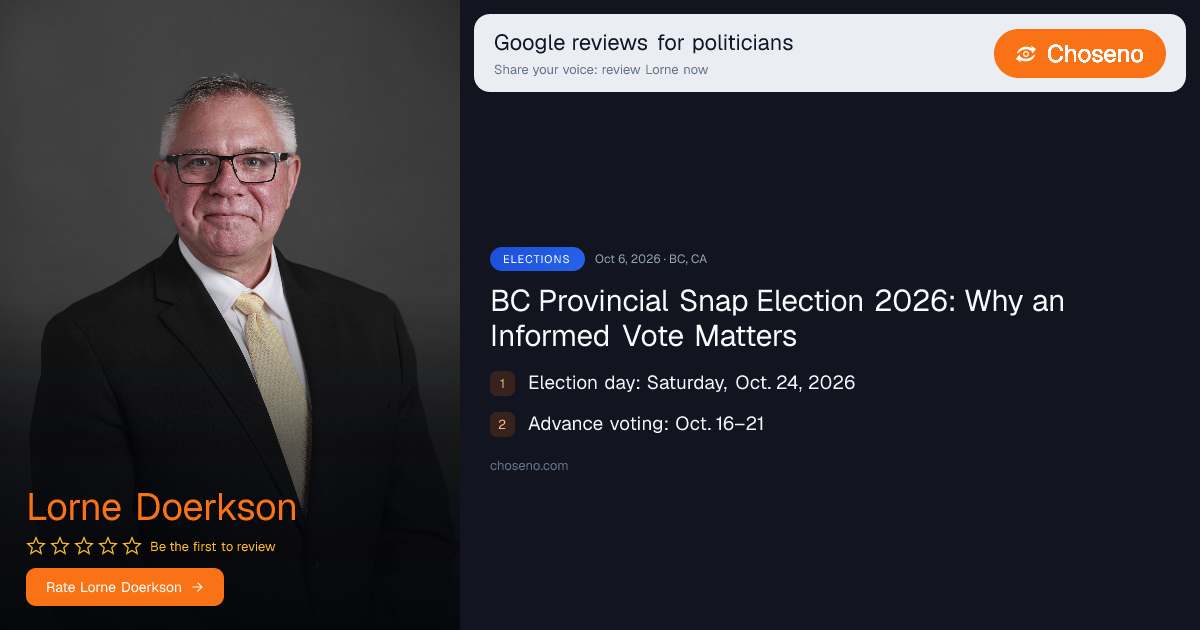
BC Provincial Snap Election 2026: Why an Informed Vote Matters
B.C. votes Oct. 24 in a snap election. Why choosing carefully matters in a democracy, and where to find each party's positions and what voters say on both sides.
Read full article
Elections
CA Oct 6, 2026
Why People Support David Eby in the 2026 BC Snap Election
What voters say they like about Premier David Eby and the BC NDP ahead of Oct. 24: housing, health care, cost of living and keeping the Conservatives out.
Read full article