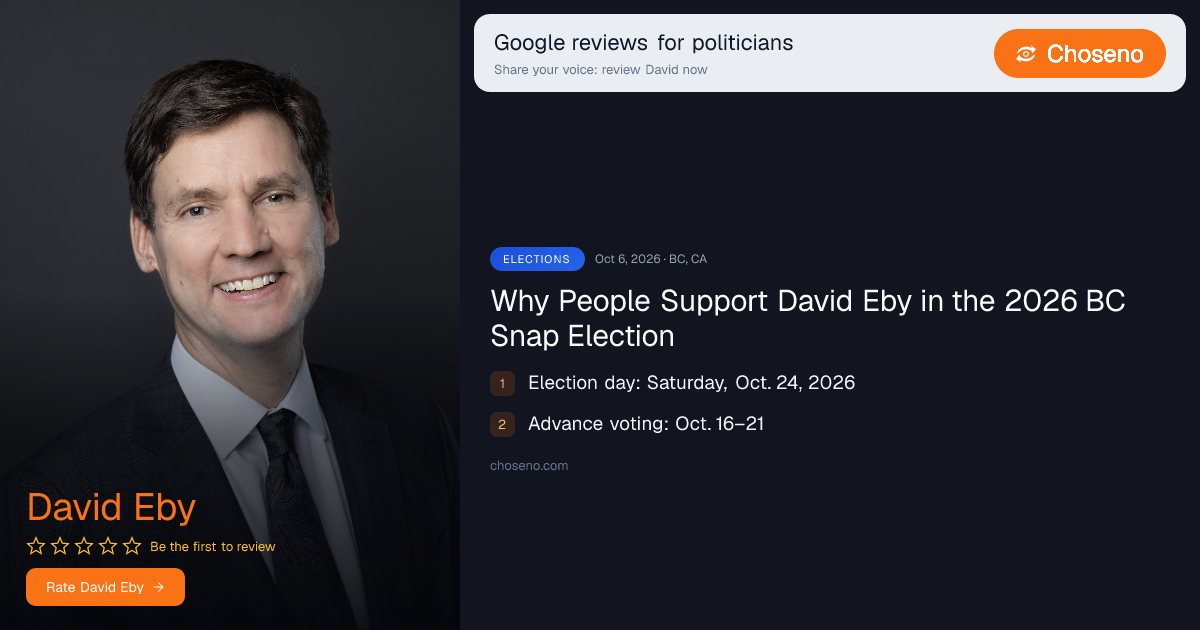
Why People Don't Want David Eby Re-elected in BC's 2026 Snap Election
From the snap election call to a $190K tax bracket, deficits and drug policy: the most common reasons voters say they won't back Premier David Eby on Oct. 24.
Choseno Civic News Desk October 7, 2026 7 min read BC, CA
Oct. 6, 2026 — Premier David Eby called a snap election for Oct. 24, 2026, and a lot of British Columbians are not happy about it. Public posts on Reddit, X and YouTube show a wave of anger aimed at Eby personally, much of it from people who say they voted NDP before. Here are the most common reasons voters say they don't want him re-elected.
BC election 2026: key dates
- Election day: Saturday, Oct. 24, 2026
- Advance voting: Oct. 16–21
- Called: Sept. 22, 2026, about two years early
Not sure who is running where you live? Use the find your district tool below to see every race on your ballot and the candidates in it.
1. The snap election itself
The single biggest source of anger after Sept. 22 is the election call. Critics say Eby still had roughly two years and a majority, and called the vote right after Conservative leader Kerry-Lynne Findlay resigned, while the opposition was in disarray. Common complaints:
- It looks like political opportunism, and some call it incompetence for letting the Conservatives regroup.
- It costs taxpayers tens of millions of dollars (commenters' estimates vary widely and we could not confirm a figure).
- It pushed aside municipal issues and left people feeling forced to vote.
- Framing it as a fight with Donald Trump, critics say, dodges BC's own problems.
Polling echoes the mood: an Angus Reid survey after the call found 65% of respondents said Eby is putting staying in power over the province's interests, against 21% who disagreed. Even some NDP supporters say they will vote for the party "but hate Eby for making me do this."
2. The "millionaire tax" that starts near $190,000
On Oct. 4, Eby announced an NDP plan to raise income tax rates for higher earners. Under it, the rate on taxable income between $190,405 and $265,545 would rise from 16.8% to 18.8%, the rate on income from $265,545 to $1 million would rise from 20.5% to 22.5%, and a new 24.5% bracket would apply above $1 million. The NDP says it would raise about $1 billion a year, start in the 2027 tax year and affect about 3.9% of income earners.
The backlash is largely about the label. Commenters say calling it a tax on millionaires is misleading, since the increases begin around $190,000 and hit doctors, tech workers, specialists, dual-income households and some trades, while people holding millions in assets are untouched. The NDP's own framing is that it targets the top few percent of earners.
Several people who say they voted NDP last time wrote that this "lost my vote." Others said they would sit the election out or vote Conservative or Green.
3. Deficit and debt
Critics blame Eby's government for moving from a surplus to large deficits and rising provincial debt, and say tax increases are cleaning up mismanagement rather than paying for better services. The underlying numbers are real: the 2026/27 deficit is projected at roughly $13–14 billion, the Fraser Institute (a think tank critical of the government) puts total provincial debt at $183.4 billion this fiscal year, and Moody's lowered B.C.'s credit rating to Aa1 in March, citing large structural deficits. The government defends the borrowing as investment in hospitals and infrastructure. A recurring contrast in posts is with former premier John Horgan, whom many describe as more measured.
4. Drugs, "safe supply" and public disorder
A durable theme from the 2024 election carried into this one. Opponents link Eby-era drug policy, including decriminalization and safe supply, to visible disorder, overdoses and theft, and say his later "get tough" turn came too late. The record is that the decriminalization pilot ended on Jan. 31, 2026, with Eby saying it "did not work," and that since February 2025 prescribed alternatives must be taken under witness. Some lifelong NDP voters say the flip-flopping eroded their trust.
5. Leadership: "I liked Horgan, I don't like Eby"
Many posts aren't about one policy at all. They describe Eby as having poor political instincts, weak messaging and unclear direction. Some say they want the NDP to win but Eby to step aside afterward, while others on the left say he has pushed the party to the right.
6. Property rights, DRIPA and housing
Homeowners and right-leaning voters cite concerns about property rights, Indigenous title uncertainty under the Declaration on the Rights of Indigenous Peoples Act (DRIPA), and density rules. On DRIPA, the government proposed amendments and then a suspension of parts of the law, and in April 2026 dropped those plans after First Nations objected. Critics from both directions point to that as evidence of an unclear position. Others say housing is still unaffordable despite years of NDP action.
7. Health care still feels broken
Unlike supporters who credit new family doctors, opponents say wait times and the number of people without a family doctor prove the government has failed, and that higher taxes won't fix it.
Who these critics appear to be
High earners and professionals in Metro Vancouver near the $190,000 line; blue-collar workers who reject being called millionaires; homeowners in areas affected by crime and disorder; interior and rural voters; lifelong NDP supporters now leaning Green or staying home; and committed Conservatives who want him out.
What critics say they will do
- Vote Conservative to remove Eby, sometimes while disliking the party's chaos.
- Switch to the Greens (a lifelong-NDP pattern).
- Sit it out.
- Vote NDP anyway because they see the Conservatives as worse. This is common on Reddit, and it is the other side of the coin of the support case.
How we gathered this
This is a qualitative read of public posts, not a poll. Choseno reviewed public comments on Reddit (r/britishcolumbia, r/vancouver, r/BCpolitics, r/VictoriaBC and others), X and YouTube from late September to Oct. 6, 2026, and grouped the recurring arguments. Online commenters skew louder and more partisan than the average voter, and Reddit leans younger and more urban.
Where a claim is a checkable fact (a date, a vote, a tax rate, a budget figure), Choseno checked it against news reports and official sources, which are linked in the sources list. Claims we could not confirm were left out. Opinions are attributed to commenters, not presented as fact.
Frequently asked questions
Why don't people want David Eby re-elected?
The most cited reasons are the snap election call, a proposed higher tax bracket starting near $190,000, the deficit and debt, drug and public-safety policy, and doubts about his leadership compared with John Horgan.
Why did Eby call an early election?
Eby called the vote on Sept. 22, 2026, about two years early, arguing voters deserve a say amid the Canada–U.S. trade fight. Critics call it opportunistic.
What is the BC millionaire tax?
An NDP proposal announced Oct. 4, 2026 to raise provincial income tax rates by 2 points on income above $190,405 and add a 24.5% bracket above $1 million, starting in 2027. Critics say the label is misleading because the increases begin well below $1 million.
Who could replace Eby?
Polls have shown the BC Conservatives, led on an interim basis by Lorne Doerkson, competitive or ahead. See our explainer on why people oppose Doerkson and why people support him.
Have your say
Tell us what you think. Vote in the polls above, then rate and review David Eby on his Choseno wall.
More BC election 2026 coverage
- BC snap election 2026: why an informed vote matters
- BC election 2026: where each party stands
- Why people support David Eby
- Why people don't support David Eby
- Why people support Lorne Doerkson
- Why people don't support Lorne Doerkson
Sources
- Choseno — BC election 2026: where each party stands
- Elections BC
- CTV News: What's next in B.C. politics after the Conservative leader's resignation
- Global News: Angus Reid poll after the snap election call
- Daily Hive: Eby's NDP proposes higher taxes on top incomes
- Fraser Institute: B.C. 2026 budget
- CTV News: Eby defends budget after credit drop
- CP24: Timeline of B.C.'s overdose emergency
- National Newswatch: Eby moving forward with First Nations after DRIPA climbdown
Which of these candidates will be on your ballot?
Find your district to see every race you can vote in, from mayor to MLA, and the candidates running in it.
Rate the people mentioned in this article

Related Coverage in Elections
See all Elections newsElections
CA Oct 9, 2026
BC Election 2026: The Most-Discussed Issues This Week
ICBC, the Conservative $1,000 tax cut, the NDP top-earner tax and a dropped candidate dominated the BC election conversation this week. Here is what each fight is about.
Read full article
Elections
CA Oct 6, 2026
BC Provincial Snap Election 2026: Why an Informed Vote Matters
B.C. votes Oct. 24 in a snap election. Why choosing carefully matters in a democracy, and where to find each party's positions and what voters say on both sides.
Read full article
Elections
CA Oct 6, 2026
Why People Support David Eby in the 2026 BC Snap Election
What voters say they like about Premier David Eby and the BC NDP ahead of Oct. 24: housing, health care, cost of living and keeping the Conservatives out.
Read full article